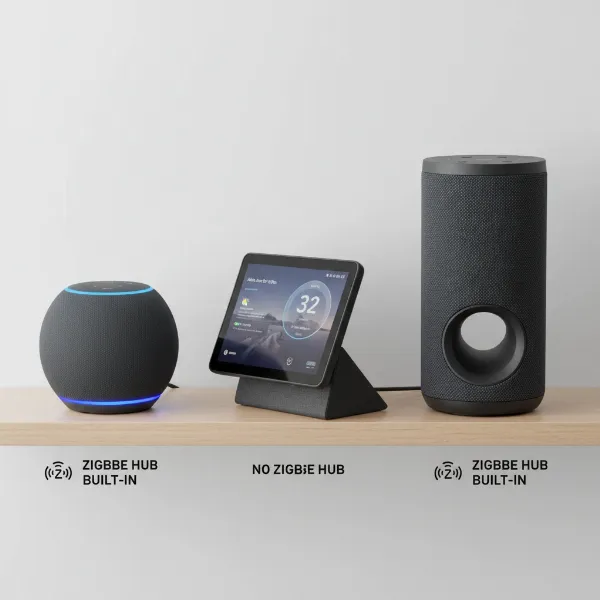
Smart speakers have revolutionized how we interact with our homes, from playing music to managing smart devices. While their built-in speakers offer a convenient audio experience, there are times when privacy or immersive listening calls for a more personal touch. Connecting Bluetooth headphones to your smart speaker unlocks a new dimension of audio, allowing you to enjoy your favorite podcasts, music, or audiobooks without disturbing others. Imagine listening to a late-night playlist or a crucial meeting without missing a beat, all while maintaining the hands-free control your smart speaker offers.
Understanding Smart Speaker Bluetooth Connectivity
|
Our Picks for the Best Smart Speaker in 2026
As an Amazon Associate I earn from qualifying purchases.
|
||
| Num | Product | Action |
|---|---|---|
| 1 | Sonos Era 100 - White - Wireless, Alexa Enabled Smart Speaker |

|
| 2 | Belkin SOUNDFORM Elite Hi-Fi Smart Speaker + Wireless Charger (Alexa Voice-Controlled Bluetooth Speaker) Sound Technology By Devialet, Fast Wireless Charging for iPhone, Samsung Galaxy & More - White |
|
| 3 | Google Audio Bluetooth Speaker - Wireless Music Streaming, Powerful Sound, Assistant Built-in, Wi-Fi and Bluetooth Connectivity, Smart Home Control, Stereo Pairing - Chalk |
|
| 4 | Mini Bluetooth Speaker, Smart Wireless Portable Speaker with Touchscreen, Loud HD Sound, LED Lights, BT5.4, All In One Small Audio for Home/Outdoor/Travel/Shower/Party/Beach/Camping/Hiking/Cycling |
|
| 5 | Bluetooth Speaker with HD Sound and Lights, Portable Wireless, Long-lasting battery life, TWS Pairing, for Home/Party/Outdoor/Travel/Beach, Stocking Stuffers, White Elephant Gifts for Adults (Black) |
|
| 6 | Portable Bluetooth Speaker Valentines Gifts For Him: Powerful Crystal Clear Sound/Romantic Light/IPX5 Waterproof/All Day Playtime/BT 5.3/TWS Paring,Small Wireless Speaker for Outdoor-Travel-Date Night |
|
| 7 | WiiM Sound Lite Smart Speaker, Hi‑Res 24‑bit/192 kHz, AI RoomFit™ Room Correction, 100W Peak, Wi‑Fi 6E/Bluetooth 5.3, Multi‑Room & Stereo Pairing, Black |
|
| 8 | aowoka Bluetooth Speaker, 2025 Portable Wireless Speakers with Led Light, Bluetooth 5.4, 24H Playtime, Enhanced Bass, IPX7 Waterproof, Outdoor Speaker for Travel, Sport, Party, Biking. |
|
| 9 | Sony SRS-XB100 Wireless Bluetooth Portable Lightweight Super-Compact Travel Speaker, Durable IP67 Waterproof & Dustproof Shower Speaker, 16 Hour Battery, Versatile Strap, & Hands-free Calling, Black |
|
| 10 | Bluetooth Speaker with HD Sound, Portable Wireless, IPX5 Waterproof, Up to 20H Playtime, TWS Pairing, BT5.3, for Home/Party/Outdoor/Beach, Electronic Gadgets, Birthday Gift (Black) |
|
Bluetooth technology is the wireless bridge that connects your headphones to your smart speaker, enabling a private audio experience. It works by creating a short-range wireless connection, transmitting audio signals from your smart speaker directly to your headphones. This means you can keep your smart speaker in the living room while you listen in the kitchen or bedroom, within Bluetooth range.
While many smart speakers support Bluetooth connectivity for receiving audio from your phone, not all are designed to output audio to external Bluetooth devices like headphones. The leading platforms, Amazon Echo (Alexa) and Google Home/Nest (Google Assistant), generally offer robust Bluetooth output capabilities, making them excellent companions for your wireless headphones.
However, it’s important to note that Apple HomePod devices take a different approach. HomePods primarily rely on Apple’s AirPlay 2 technology for audio streaming within the Apple ecosystem. They do not natively support direct Bluetooth audio output to headphones, distinguishing them from their Amazon and Google counterparts. If you own an Apple HomePod, you’ll typically stream audio to it from an Apple device, and then connect your headphones to that Apple device instead, or use AirPlay 2 compatible headphones if available.
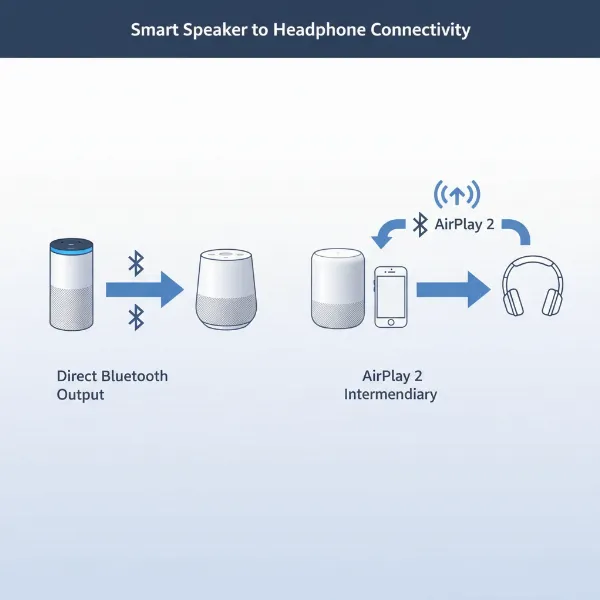 Illustration of different smart speaker Bluetooth headphone connectivity: Amazon Echo and Google Home connect directly, Apple HomePod uses AirPlay.
Step-by-Step Guide: Connecting Bluetooth Headphones to Amazon Echo (Alexa)
Connecting your Bluetooth headphones to an Amazon Echo device is a straightforward process, primarily managed through the Alexa app or with simple voice commands.
1. Prepare Your Headphones:
First, ensure your Bluetooth headphones are fully charged and in pairing mode. Most headphones indicate pairing mode with a flashing LED light or a voice prompt. Refer to your headphone’s manual if you’re unsure how to activate pairing mode.
2. Using the Alexa App (Recommended for First-Time Pairing):
This method offers a visual and often more reliable way to establish the initial connection.
- Open the Alexa app on your smartphone or tablet.
- Tap the “Devices” icon at the bottom right.
- Select “Echo & Alexa” from the list.
- Choose the specific Echo device you wish to pair with your headphones.
- Scroll down and tap “Bluetooth Devices”.
- Tap “Pair A New Device”. Your Echo device will now search for nearby Bluetooth headphones in pairing mode.
- Select your headphones from the list that appears. The Alexa app will confirm once the connection is successful.
3. Using Voice Commands:
While the app is great for initial setup, voice commands are convenient for subsequent connections.
- Once your headphones are in pairing mode, say, “Alexa, pair Bluetooth” or “Alexa, connect Bluetooth.”
- Alexa will then search for and attempt to connect to the last paired Bluetooth device or a new one in pairing mode.
- Alexa will confirm the connection vocally once established.
After the initial pairing, your Echo device should automatically reconnect to your headphones when they are in range and turned on. If not, a quick “Alexa, connect to my headphones” usually does the trick.
Step-by-Step Guide: Connecting Bluetooth Headphones to Google Home/Nest
Connecting Bluetooth headphones to your Google Home or Nest speaker is also simple, primarily handled through the Google Home app.
1. Prepare Your Headphones:
Just like with Alexa, make sure your Bluetooth headphones are charged and set to pairing mode. Look for the flashing indicator light or listen for the voice prompt.
2. Using the Google Home App (Recommended for Pairing):
The Google Home app provides a clear interface for managing Bluetooth connections.
- Open the Google Home app on your smartphone or tablet.
- On the home screen, select your specific Google Home or Nest device.
- Tap the settings icon (gear-shaped) in the top right corner.
- Scroll down and select “Audio”, then “Paired Bluetooth devices”.
- Tap “Enable Pairing Mode” or “Pair Bluetooth speaker”. Your Google Home device will begin scanning for nearby Bluetooth devices.
- Select your headphones from the list of available devices.
- Once connected, the Google Home app will provide a confirmation, and you should hear a chime or voice prompt.
3. Using Voice Commands:
For quick reconnections, voice commands are incredibly useful.
- To initiate pairing, say, “Hey Google, pair Bluetooth.” Your device will enter pairing mode and instruct you to check the Google Home app.
- To reconnect to an already paired device, simply say, “Hey Google, connect Bluetooth.”
Using the Google Home app for the initial pairing ensures a smooth setup. For daily use, voice commands make it effortless to switch to private listening.
What About Apple HomePod? Understanding AirPlay Instead of Bluetooth
If you’re an Apple HomePod or HomePod mini owner hoping to connect Bluetooth headphones directly, you might find yourself in a different ecosystem. Apple’s HomePod speakers are not designed to output audio to Bluetooth headphones. Instead, they leverage AirPlay 2 for seamless audio streaming.
AirPlay 2 allows you to stream audio from your iPhone, iPad, Mac, or Apple TV directly to your HomePod over your Wi-Fi network. This system prioritizes high-fidelity audio and multi-room synchronization within the Apple ecosystem. Therefore, if you want to listen privately from your HomePod’s audio source, you would typically:
- Play content on your HomePod.
- Connect your Bluetooth headphones directly to your iPhone, iPad, or Mac.
- Then, use your Apple device to stream the audio you want to listen to through your headphones, rather than trying to send it from the HomePod to your headphones.
This distinction is crucial for Apple users to understand when integrating headphones into their smart home audio setup.
Troubleshooting Common Connection Issues
Even with clear instructions, you might occasionally encounter hiccups when connecting your Bluetooth headphones. Here are some common issues and their solutions:
-
Headphones Not Appearing in the List:
- Ensure Pairing Mode: Double-check that your headphones are truly in pairing mode. Many have a specific button or sequence to activate it.
- Proximity: Bring your headphones closer to the smart speaker.
- Interference: Temporarily turn off Bluetooth on other nearby devices (phones, tablets) that might be trying to connect to your headphones.
- Reboot: Try restarting your smart speaker (unplug and replug) and your headphones.
- Check Battery: Make sure your headphones have sufficient battery life.
-
Disconnection Problems:
- Range: You might be moving too far from your smart speaker. Bluetooth generally works best within 30 feet (10 meters).
- Interference: Other wireless devices (Wi-Fi routers, microwaves) can interfere. Try moving them further away.
- Firmware Updates: Ensure both your smart speaker and headphones have the latest firmware updates installed, as these often include bug fixes for connectivity.
-
Sound Quality Issues (Choppy Audio, Low Volume):
- Re-pair: Disconnect and re-pair your headphones.
- Volume Levels: Check the volume on both your headphones and your smart speaker/app.
- Codecs: Some Bluetooth headphones and smart speakers support different audio codecs. While typically automatic, occasional incompatibilities can occur.
If problems persist, consult the support pages for your specific smart speaker model and headphones.
Maximizing Your Smart Speaker and Headphone Experience
Connecting headphones to your smart speaker opens up a world of convenience. Here are some tips to enhance your listening:
- Private Listening: Enjoy music, podcasts, or audiobooks without disturbing housemates or neighbors, perfect for late-night sessions or focused work.
- Enhanced Audio Quality: If your smart speaker has moderate sound quality, high-fidelity Bluetooth headphones can significantly improve your listening experience.
- Voice Assistant Privacy: Use your headphones to hear responses from Alexa or Google Assistant privately, especially useful for personal inquiries or sensitive information.
- Seamless Switching: Most smart speakers remember previously paired devices. You can usually switch between the built-in speaker and your headphones with a voice command or through the companion app. For example, “Alexa, disconnect my headphones” or “Hey Google, connect Bluetooth.”
- Optimal Placement: Even when using headphones, ensure your smart speaker is in a good location for hearing your voice commands, as the microphone on the smart speaker is still active.
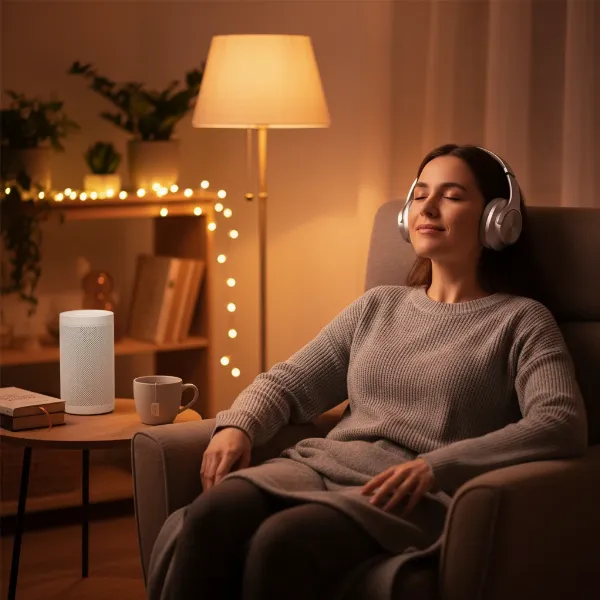 A person relaxing and privately listening to music or an audiobook through headphones connected to a smart speaker.
Comparison Table: Smart Speaker Bluetooth Output Features
| Smart Speaker Brand | Bluetooth Output to Headphones | Primary Control Method | Notes |
|---|---|---|---|
| Amazon Echo | Yes | Alexa app, Voice | Robust support for streaming audio to most Bluetooth headphones. The Alexa app provides detailed pairing management. |
| Google Home/Nest | Yes | Google Home app, Voice | Seamlessly connects to Bluetooth headphones for private listening. The Google Home app is central to managing these connections. |
| Apple HomePod | No (AirPlay 2 only) | AirPlay from iOS/macOS | Primarily designed as an AirPlay speaker; does not support direct Bluetooth audio output to external headphones. |
Conclusion
Connecting Bluetooth headphones to your Smart Speaker is an incredibly useful feature that enhances privacy, improves audio quality, and provides greater flexibility in how you consume content. While Amazon Echo and Google Home/Nest devices offer straightforward pairing processes via their respective apps and voice commands, Apple HomePod takes a different route, relying on AirPlay for its ecosystem. Understanding these distinctions ensures you can set up your devices efficiently and enjoy a personalized audio experience whenever you need it.
So, are you ready to dive into your audio world without limits?