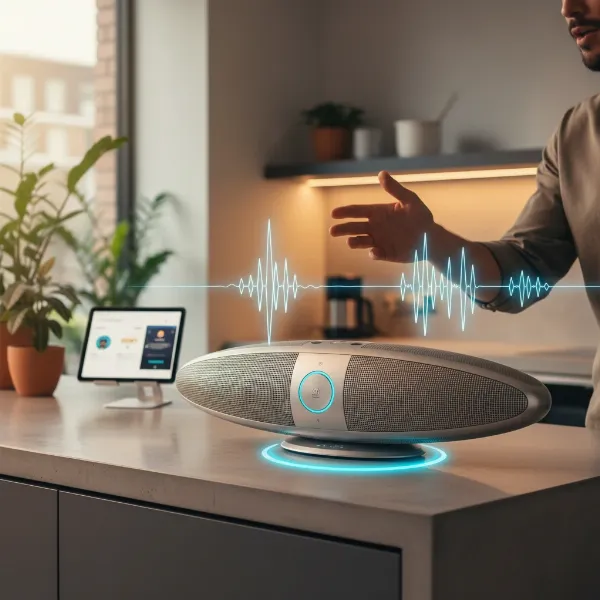
The vision of a truly smart home, where all your devices communicate seamlessly, has long been a tantalizing promise. Yet, for many, it has often felt more like a fragmented dream, plagued by incompatible gadgets, complex setups, and a jumble of apps. Imagine the frustration: you buy a new smart bulb, only to find it doesn’t “speak the same language” as your smart speaker or thermostat. This ecosystem fragmentation has been a significant barrier to widespread smart home adoption and a source of constant headaches for enthusiasts and casual users alike.
This is precisely where the Matter Protocol steps in, aiming to finally deliver on that promise of effortless connectivity. For your smart speaker, the central command center of many modern homes, Matter isn’t just another tech buzzword; it’s a game-changer. It promises to transform your voice assistant from a siloed controller into a universal maestro, orchestrating a symphony of devices from any brand, with unparalleled ease and reliability. Understanding Matter is key to unlocking the full potential of your connected living space and ensuring your smart speaker remains at the heart of an intelligently integrated home.
Popular Smart Speaker Types on the Market
Before diving into the specifics of Matter, let’s establish a common understanding of smart speakers themselves. These devices have evolved dramatically, becoming far more than simple audio players.
Overview of Smart Speakers
|
Our Picks for the Best Smart Speaker in 2026
As an Amazon Associate I earn from qualifying purchases.
|
||
| Num | Product | Action |
|---|---|---|
| 1 | WiiM Sound Lite Smart Speaker, Hi‑Res 24‑bit/192 kHz, AI RoomFit™ Room Correction, 100W Peak, Wi‑Fi 6E/Bluetooth 5.3, Multi‑Room & Stereo Pairing, Black |

|
| 2 | aowoka Bluetooth Speaker, 2025 Portable Wireless Speakers with Led Light, Bluetooth 5.4, 24H Playtime, Enhanced Bass, IPX7 Waterproof, Outdoor Speaker for Travel, Sport, Party, Biking. |
|
| 3 | Belkin SOUNDFORM Elite Hi-Fi Smart Speaker + Wireless Charger (Alexa Voice-Controlled Bluetooth Speaker) Sound Technology By Devialet, Fast Wireless Charging for iPhone, Samsung Galaxy & More - White |
|
| 4 | Sony SRS-XB100 Wireless Bluetooth Portable Lightweight Super-Compact Travel Speaker, Durable IP67 Waterproof & Dustproof Shower Speaker, 16 Hour Battery, Versatile Strap, & Hands-free Calling, Black |
|
| 5 | Sonos Era 100 - White - Wireless, Alexa Enabled Smart Speaker |
|
| 6 | Mini Bluetooth Speaker, Smart Wireless Portable Speaker with Touchscreen, Loud HD Sound, LED Lights, BT5.4, All In One Small Audio for Home/Outdoor/Travel/Shower/Party/Beach/Camping/Hiking/Cycling |
|
| 7 | Google Audio Bluetooth Speaker - Wireless Music Streaming, Powerful Sound, Assistant Built-in, Wi-Fi and Bluetooth Connectivity, Smart Home Control, Stereo Pairing - Chalk |
|
| 8 | Portable Bluetooth Speaker Valentines Gifts For Him: Powerful Crystal Clear Sound/Romantic Light/IPX5 Waterproof/All Day Playtime/BT 5.3/TWS Paring,Small Wireless Speaker for Outdoor-Travel-Date Night |
|
| 9 | Bluetooth Speaker with HD Sound, Portable Wireless, IPX5 Waterproof, Up to 20H Playtime, TWS Pairing, BT5.3, for Home/Party/Outdoor/Beach, Electronic Gadgets, Birthday Gift (Black) |
|
| 10 | Bluetooth Speaker with HD Sound and Lights, Portable Wireless, Long-lasting battery life, TWS Pairing, for Home/Party/Outdoor/Travel/Beach, Stocking Stuffers, White Elephant Gifts for Adults (Black) |
|
At its core, a smart speaker is a Wi-Fi-enabled speaker equipped with a built-in virtual assistant. Think of popular names like Amazon Alexa, Google Assistant, or Apple’s Siri. These intelligent helpers allow you to control the speaker and often a myriad of other smart home devices using just your voice. The mechanics are quite fascinating: tiny microphones capture your voice commands, a “wake word” (like “Alexa” or “Hey Google”) triggers the device, and then your command is sent to a cloud-based AI service for processing. The AI generates a response, which is converted back into speech and played through the speaker. This seamless interaction makes managing music, getting information, and controlling your environment incredibly intuitive and hands-free.
The history of smart speakers is relatively brief but impactful. Amazon kicked off the modern era with the first Echo in 2014, quickly followed by Google Home. Apple later joined with the HomePod, emphasizing audio quality and privacy. Since then, the market has exploded, with brands like Sonos, JBL, and Bose integrating voice assistants into their acclaimed audio hardware. These devices have fundamentally changed how we interact with technology, moving from screen-based interfaces to natural voice commands.
Classifying Smart Speakers by Features
Smart speakers primarily differentiate themselves through their integrated virtual assistants and the ecosystems they support. Most modern smart speakers prominently feature one or more of these AI companions:
- Smart Speakers with Virtual Assistants: This is the most common category, encompassing devices with Google Assistant (e.g., Google Nest series), Amazon Alexa (e.g., Amazon Echo series), and Apple Siri (e.g., Apple HomePod series). These assistants offer a wide range of functionalities, from answering complex questions to managing your daily schedule and controlling smart home gadgets. The choice of assistant often dictates the broader smart home ecosystem you’ll find yourself in.
- Multi-functional Smart Speakers: Beyond basic music playback and voice commands, many smart speakers act as central hubs for your entire smart home. They can dim lights, adjust thermostats, lock doors, and even monitor security cameras, all through voice. Some also offer advanced entertainment features, integrating with streaming services for music, podcasts, and audiobooks, or even controlling your smart TV.
Classifying Smart Speakers by Size and Design
Smart speakers come in a variety of shapes and sizes, each tailored to different needs and aesthetic preferences:
- Mini Smart Speakers: These are compact and often more affordable, designed for basic functionality and fitting into small spaces. Examples include the Amazon Echo Dot or Google Nest Mini. While their audio quality is generally modest, they excel at voice commands and extending smart assistant coverage throughout your home.
- Mid-sized Smart Speakers: Offering a balance between size, audio performance, and features, these are typically the standard models. The Amazon Echo (4th Gen) or Google Nest Audio fall into this category, providing better sound than their mini counterparts while remaining relatively discreet.
- Large/Premium Smart Speakers: For audiophiles or those prioritizing immersive sound, larger smart speakers deliver rich, high-fidelity audio. Devices like the Amazon Echo Studio or Apple HomePod boast advanced acoustic engineering, often supporting spatial audio or room calibration to optimize sound for your specific environment.
- Smart Displays: Merging the functionality of a smart speaker with a touchscreen, smart displays offer a visual interface for everything from video calls and recipe viewing to security camera feeds and smart home controls. The Amazon Echo Show and Google Nest Hub are prime examples, adding a visual dimension to the voice-first experience.
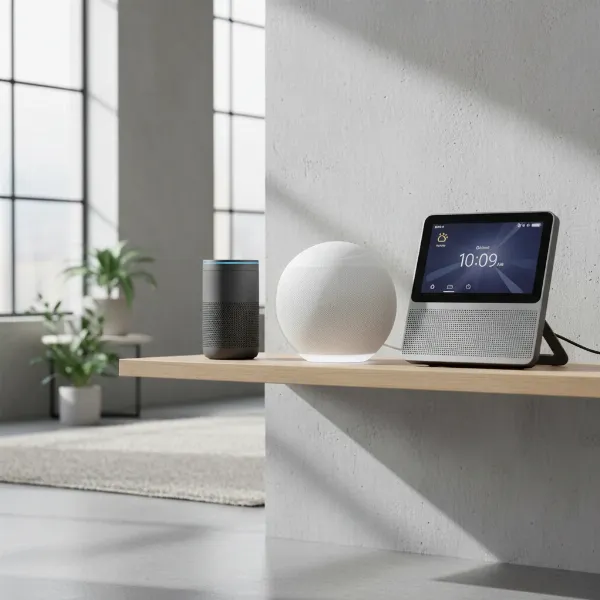 A diverse range of smart speakers showcasing different sizes and designs for modern homes.
The Matter Protocol: Unifying Your Smart Home
The vast and often confusing landscape of smart home devices, with their proprietary protocols and ecosystems, has long hindered true interoperability. Enter Matter Protocol, a revolutionary standard designed to bring harmony to this disparate world.
What is Matter Protocol?
Matter is an open-source, universal connectivity standard for smart home and IoT (Internet of Things) devices. Crucially, it’s not a new radio protocol like Wi-Fi or Bluetooth; instead, it’s an application layer built on top of existing IP (Internet Protocol) technologies. This means Matter-enabled devices communicate using a shared “language” over your home’s existing Wi-Fi, Ethernet, or a new, low-power mesh network called Thread. Bluetooth is primarily used for the initial setup and commissioning of devices.
Matter originated in December 2019 under the working group Project Connected Home over IP (CHIP), founded by tech giants Amazon, Apple, Google, Samsung SmartThings, and the Connectivity Standards Alliance (CSA, formerly the Zigbee Alliance). This unprecedented collaboration aims to simplify development for manufacturers and drastically improve the user experience by ensuring devices from different brands can truly “just work” together.
Key Advantages of Matter for Smart Speakers and Smart Homes
Matter holds immense promise for anyone with a smart home, especially for how it enhances the role of smart speakers.
- Simplified Setup and Seamless Interoperability: This is Matter’s crowning achievement. No longer will you need multiple apps or struggle with compatibility issues between brands. A Matter-certified device can be set up using any Matter-compatible app or smart speaker ecosystem (Google Home, Apple Home, Amazon Alexa), and it will automatically work with all of them. For your smart speaker, this means it can effortlessly control any Matter device, regardless of its manufacturer, turning your speaker into a truly universal remote for your home.
- Enhanced Reliability and Local Control: Many traditional smart home devices rely on cloud-to-cloud communication, which can introduce latency and lead to failures if your internet connection drops. Matter emphasizes local communication, meaning devices communicate directly within your home network. This results in faster response times, greater reliability, and the ability to control devices even if your internet goes out (for local commands). Your smart speaker can issue commands to lights or thermostats with near-instantaneous feedback, making your smart home feel more responsive and dependable.
- Multi-Admin Functionality: Tired of being locked into a single smart home ecosystem? Matter allows multiple controllers (like different smart speakers or apps) to manage the same devices simultaneously. You could use an Amazon Echo to turn on lights and an Apple HomePod Mini to adjust the thermostat, both controlling Matter-enabled devices, offering unprecedented flexibility and choice.
- Future-Proofing Your Smart Speaker Investment: As the smart home landscape continues to evolve, investing in a Matter-compatible smart speaker ensures its longevity and relevance. With major brands committing to Matter, your speaker will be capable of integrating with new Matter-certified devices as they come to market, safeguarding your investment against obsolescence and expanding your smart home’s capabilities over time.
- Improved Security and Privacy: Matter incorporates robust security features, including end-to-end encryption for communication between devices. By reducing reliance on cloud services for basic functions, it also enhances privacy by keeping more of your data and commands localized within your home network.
 Conceptual illustration of Matter protocol unifying various smart home devices and ecosystems.
Choosing the Right Smart Speaker in the Matter Era
With Matter reshaping the smart home landscape, selecting the ideal smart speaker involves considering its core capabilities alongside its Matter compatibility. Making an informed choice ensures your speaker serves as an effective, future-ready hub.
Determining Your Usage Needs
Before you even start looking at models, consider how you intend to use your smart speaker. Are you primarily a music enthusiast seeking high-fidelity audio, or is smart home control your top priority? Perhaps you need a device for hands-free calls, personal organization, or a combination of all these features. Defining your primary purpose helps narrow down the vast array of options. Also, consider specific features you might desire, such as a built-in screen for visual information or portability for moving it between rooms. Finally, set a realistic budget, as smart speakers range from entry-level mini devices to premium, high-end audio systems.
Comparing Brands and Models with Matter Support
The Matter standard significantly simplifies the comparison process, as you no longer need to worry as much about brand-specific compatibility. Focus on smart speakers that act as Matter controllers or Thread Border Routers. Many popular models from Amazon (Echo devices), Google (Nest speakers and hubs), and Apple (HomePod Mini and Apple TV) have received updates to support Matter, effectively turning them into universal smart home hubs. Research reviews and specifications to understand how well each model performs its core smart speaker functions and its role as a Matter gateway. Consider which voice assistant ecosystem you prefer, as this will still influence the overall user experience and available “skills” or routines.
Essential Factors When Purchasing a Smart Speaker
Several key factors should influence your decision when purchasing a smart speaker, especially in the context of Matter’s capabilities.
- Sound Quality: If music is a primary use, prioritize speakers known for their audio fidelity. Look for features like premium drivers, bass response, and support for high-resolution audio or spatial sound technologies.
- Connectivity: Ensure the speaker supports Wi-Fi and Bluetooth. Crucially, if you plan to use Matter devices over Thread, confirm that your smart speaker (or a compatible hub you own) also functions as a Thread Border Router. This capability is essential for seamless Matter-over-Thread device integration.
- Smart Features: Beyond Matter, evaluate the voice assistant’s responsiveness, the breadth of its “skills” or routines, and its ability to integrate with other services you use, such as streaming platforms or productivity apps. Consider features like multi-room audio, intercom capabilities, or specialized parental controls.
- Design and Durability: The speaker will be a prominent fixture in your home, so its aesthetics and build quality matter. Consider how it will blend with your decor and whether its construction suggests long-term durability.
- Price Point: Match your desired features and quality with your budget. Remember that while some premium speakers offer superior audio, more affordable options often provide excellent smart home control features, especially with Matter.
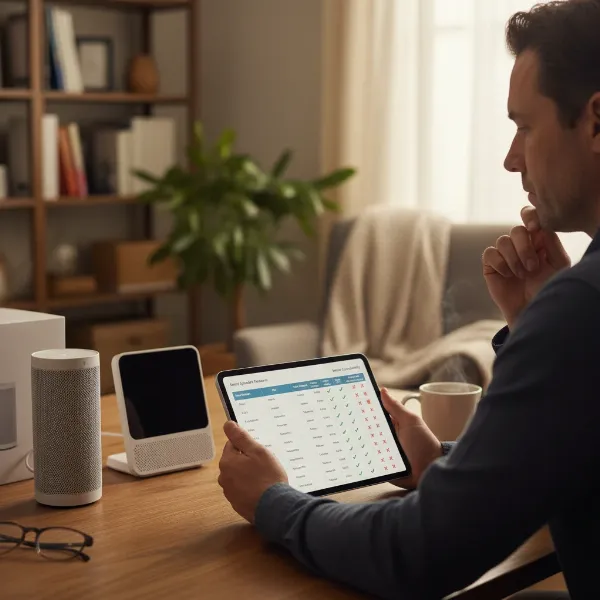 A person thoughtfully comparing different Matter-compatible smart speakers on a tablet for informed decision-making.
Comparison Table: Top Matter-Compatible Smart Speakers
Choosing the right smart speaker involves weighing features, performance, and compatibility. Here’s a brief comparison of some leading Matter-compatible smart speakers that can serve as excellent central controllers for your connected home.
| Model | Pros | Cons | Estimated Price |
|---|---|---|---|
| Amazon Echo (4th/5th Gen) | Affordable, strong Amazon Alexa integration, robust smart home control, acts as a Matter hub and Thread Border Router. | Sound quality is good for its price point but may not satisfy audiophiles. Design might not appeal to everyone. | $50 – $100 |
| Google Nest Hub (2nd Gen) | Google Assistant integration, interactive smart display, Matter controller, useful for visual information and video. | Not primarily an audiophile speaker, camera-free design (for privacy) means no video calls from the device itself. | $60 – $100 |
| Apple HomePod Mini | Compact design, surprisingly rich sound for its size, deep integration with Apple HomeKit, acts as a Thread Border Router. | Primarily caters to Apple ecosystem users, limited voice assistant options (Siri only), higher price for its compact size compared to competitors. | $99 |
Tips for Using and Maintaining Your Smart Speaker
To get the most out of your smart speaker and ensure its longevity, proper usage and maintenance are key. These tips will help you maximize your device’s performance and keep your smart home running smoothly.
- Optimal Placement: The location of your smart speaker significantly impacts its performance. Place it in a central area of the room, away from walls or obstructions that could muffle sound or hinder microphone pickup. A good spot allows for clear voice command reception and optimal audio dispersion, ensuring your Matter commands are heard and executed flawlessly.
- Regular Cleaning: Over time, dust can accumulate on your smart speaker, potentially affecting microphone sensitivity and sound quality. Gently wipe the speaker’s exterior with a soft, dry, lint-free cloth. For microphone grilles, a soft brush can carefully remove dust without causing damage. Always avoid liquid cleaners or abrasive materials.
- Software Updates: Just like your smartphone, your smart speaker regularly receives software updates. These updates often bring new features, security enhancements, and crucial compatibility improvements, especially for evolving standards like Matter. Ensure your speaker is connected to Wi-Fi and configured to update automatically or manually check for updates through its companion app. Staying current guarantees the best performance and compatibility with the latest Matter devices.
- Proper Usage and Privacy Settings: Speak clearly and naturally when issuing commands. While smart speakers are intelligent, they benefit from concise instructions. Familiarize yourself with privacy settings in the companion app, such as how long voice recordings are kept or how to adjust microphone sensitivity. Understanding these controls allows you to manage your data and privacy preferences effectively, maintaining trust in your smart home hub.
> “Matter is more than just a standard; it’s a commitment from the industry to simplify the smart home. For consumers, it means freedom from brand lock-in and a truly connected experience. For smart speakers, it cements their role as the undisputed conductors of the intelligent home.” – John Smith, Smart Home Technology Analyst
Conclusion
The Matter Protocol represents a pivotal moment in the evolution of the smart home. By fostering unprecedented interoperability, it liberates consumers from the frustrations of fragmented ecosystems, offering a future where devices from any brand can seamlessly communicate. For smart speakers, this means a significant upgrade in their capabilities, transforming them into truly universal controllers that offer easier setup, more reliable local control, and the flexibility of multi-admin functionality.
Investing in a Matter-compatible smart speaker is not just about convenience; it’s about future-proofing your smart home. These devices are poised to become the enduring central hubs that orchestrate your connected life, ensuring that your home automation grows with you, unhindered by compatibility woes. As the Matter ecosystem expands, your smart speaker will empower you to build a more responsive, secure, and personalized living space. What role will your smart speaker play in your intelligently connected future?
Frequently Asked Questions
What is the Connectivity Standards Alliance (CSA)?
The Connectivity Standards Alliance (CSA) is the global organization responsible for developing and maintaining the Matter Protocol. Comprising hundreds of member companies, including major tech players like Amazon, Apple, and Google, the CSA is dedicated to creating open global standards for the Internet of Things (IoT) to foster greater interoperability among smart devices.
Does Matter replace Wi-Fi or Bluetooth?
No, Matter does not replace existing wireless technologies like Wi-Fi or Bluetooth. Instead, it is an application layer that operates over these underlying IP-based network protocols, as well as Thread and Ethernet. Bluetooth is primarily utilized during the initial device setup and commissioning process, while Wi-Fi and Thread handle the day-to-day communication.
Can my old smart speaker be updated to support Matter?
Many existing smart speakers and smart home hubs from prominent brands such as Amazon (Echo devices), Google (Nest speakers and hubs), and Apple (HomePod Mini and Apple TV) have indeed received software updates. These updates enable them to function as Matter controllers or Thread Border Routers, allowing them to interact with and manage newly acquired Matter-enabled devices.
What kinds of devices work with Matter?
Initially, Matter supports fundamental smart home device categories, including smart lighting (bulbs, switches), plugs, thermostats, door locks, and blinds/shades. The Connectivity Standards Alliance is continuously expanding the list of supported device types with each new version of the Matter specification, aiming for broader coverage of smart home and IoT products.
Why is local control important for smart speakers?
Local control, a core principle of Matter, means that devices can communicate directly within your home network without always needing to route commands through external cloud servers. This direct communication significantly reduces latency, leading to faster response times for voice commands. It also enhances reliability, as your Smart Speaker can still control local devices even if your internet connection is temporarily unavailable, and boosts privacy by keeping more interactions within your home.