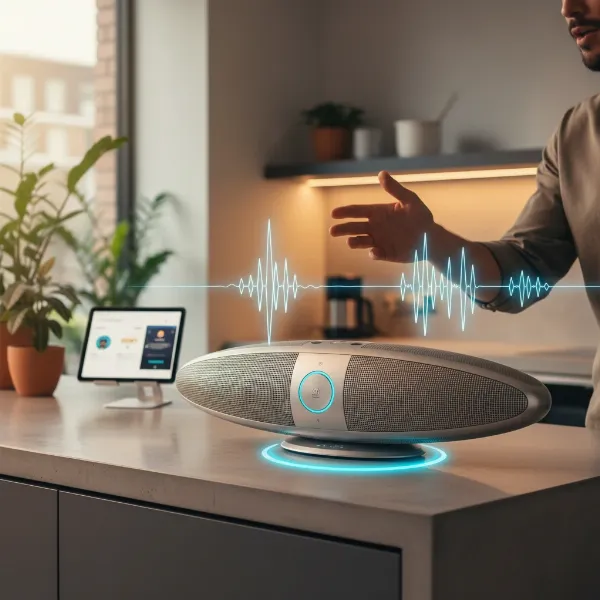
Do you ever get that unsettling feeling that your smart speaker might be a digital eavesdropper, silently recording every private conversation within your home? Many smart speaker owners share this concern, often wondering if their devices are truly “always listening” in a way that compromises their privacy. The truth, however, is more nuanced than widespread fear might suggest. While these devices are designed to constantly monitor for a specific command, understanding the technicalities and adopting proactive measures can help you regain control and peace of mind over your smart home experience.
Understanding How Smart Speakers “Listen”
The core of the “always listening” myth lies in how smart speakers process audio. They are, in a sense, always listening, but there’s a critical distinction between passive monitoring and active recording.
Passive Listening vs. Active Recording: The Wake Word Mechanism
|
Our Picks for the Best Smart Speaker in 2026
As an Amazon Associate I earn from qualifying purchases.
|
||
| Num | Product | Action |
|---|---|---|
| 1 | Sony SRS-XB100 Wireless Bluetooth Portable Lightweight Super-Compact Travel Speaker, Durable IP67 Waterproof & Dustproof Shower Speaker, 16 Hour Battery, Versatile Strap, & Hands-free Calling, Black |

|
| 2 | aowoka Bluetooth Speaker, 2025 Portable Wireless Speakers with Led Light, Bluetooth 5.4, 24H Playtime, Enhanced Bass, IPX7 Waterproof, Outdoor Speaker for Travel, Sport, Party, Biking. |
|
| 3 | Portable Bluetooth Speaker Valentines Gifts For Him: Powerful Crystal Clear Sound/Romantic Light/IPX5 Waterproof/All Day Playtime/BT 5.3/TWS Paring,Small Wireless Speaker for Outdoor-Travel-Date Night |
|
| 4 | Sonos Era 100 - White - Wireless, Alexa Enabled Smart Speaker |
|
| 5 | Bluetooth Speaker with HD Sound, Portable Wireless, IPX5 Waterproof, Up to 20H Playtime, TWS Pairing, BT5.3, for Home/Party/Outdoor/Beach, Electronic Gadgets, Birthday Gift (Black) |
|
| 6 | Google Audio Bluetooth Speaker - Wireless Music Streaming, Powerful Sound, Assistant Built-in, Wi-Fi and Bluetooth Connectivity, Smart Home Control, Stereo Pairing - Chalk |
|
| 7 | Bluetooth Speaker with HD Sound and Lights, Portable Wireless, Long-lasting battery life, TWS Pairing, for Home/Party/Outdoor/Travel/Beach, Stocking Stuffers, White Elephant Gifts for Adults (Black) |
|
| 8 | WiiM Sound Lite Smart Speaker, Hi‑Res 24‑bit/192 kHz, AI RoomFit™ Room Correction, 100W Peak, Wi‑Fi 6E/Bluetooth 5.3, Multi‑Room & Stereo Pairing, Black |
|
| 9 | Belkin SOUNDFORM Elite Hi-Fi Smart Speaker + Wireless Charger (Alexa Voice-Controlled Bluetooth Speaker) Sound Technology By Devialet, Fast Wireless Charging for iPhone, Samsung Galaxy & More - White |
|
| 10 | Mini Bluetooth Speaker, Smart Wireless Portable Speaker with Touchscreen, Loud HD Sound, LED Lights, BT5.4, All In One Small Audio for Home/Outdoor/Travel/Shower/Party/Beach/Camping/Hiking/Cycling |
|
Smart speakers, such as the Amazon Echo, Google Home, and Apple HomePod, feature always-on microphones that operate in a low-power, passive listening mode. In this state, the device continuously analyzes ambient audio locally for a specific “wake word” or phrase—like “Alexa,” “Hey Google,” or “Hey Siri.” This local processing is crucial; it means the audio isn’t immediately sent to cloud servers. Instead, the device processes a short, self-deleting loop of sound, constantly overwriting itself within seconds. It’s akin to your ears being open, but your brain only engaging when it hears your name.
Only when the designated wake word is detected does the smart speaker transition to an active listening state. At this point, it begins to record the subsequent audio and transmits it securely to the manufacturer’s cloud servers for processing and to fulfill your request. This is how it differentiates between casual conversation and a direct command.
The Reality of Accidental Activations
Despite sophisticated wake word detection, smart speakers are not infallible. Accidental activations are a common phenomenon where the device mistakenly hears something similar to its wake word in everyday conversation, triggering an unintended recording. Studies have shown that these false activations can occur multiple times a day, leading to snippets of private discussions being sent to the cloud. While these incidents are often brief, they underscore the importance of understanding your device’s behavior and managing its privacy settings.
Beyond the Wake Word: What Data Do Smart Speakers Collect?
Once activated by a wake word, smart speakers collect and process your voice commands. This data is essential for the device to function effectively, but the extent and duration of its storage vary by manufacturer.
Voice Recordings and Transcripts
When you interact with your smart speaker, your voice commands are recorded and transcribed into text. This data is then used to understand your requests, provide responses, and continuously improve the device’s speech recognition capabilities. Over time, these interactions help the smart speaker learn your preferences, accents, and even habits, making for a more personalized experience.
How Major Brands Handle Your Data
Each major smart speaker provider has its own approach to data collection, storage, and retention:
- Google (Google Home/Nest): By default, Google generally does not retain audio recordings on its servers. Users have the option to review and manage their activity, including voice recordings, in their Google Account settings.
- Amazon (Echo/Alexa): Amazon devices record interactions after the wake word is detected. By default, Amazon retains these voice recordings indefinitely unless the user manually deletes them or sets a specific retention period. Users can easily review and delete their voice history through the Alexa app or web portal.
- Apple (HomePod/Siri): Apple emphasizes on-device processing for many Siri requests, meaning much of your interaction is handled locally without being sent to the cloud. When a request does require server processing, the data is encrypted and anonymized. Apple’s policy states that recordings are not retained unless you explicitly opt-in, and generally stores only the minimum required data for up to six months.
Unmasking the Myths: Common Privacy Concerns
Let’s address some of the most persistent myths surrounding smart speaker privacy head-on.
Myth 1: Smart Speakers Are Constantly Recording and Sending Everything to the Cloud
This is perhaps the most pervasive myth, fueled by sensational headlines. As established, smart speakers are always listening in a passive state for their wake word. However, they are not constantly recording and transmitting your entire household’s conversations to the cloud. The vast majority of audio processing in the passive state occurs locally on the device, with audio snippets being immediately overwritten if the wake word is not detected. This localized processing prevents continuous, unwarranted surveillance.
Myth 2: My Data is Perfectly Secure
While major manufacturers invest heavily in cybersecurity, no system is entirely impervious. Smart speakers, like any internet-connected device, carry inherent security risks.
“The convenience of smart speakers often leads users to overlook potential privacy vulnerabilities. It’s a trade-off where vigilance is key.” – Dr. Anya Sharma, Cybersecurity Ethicist
- Hacking Risks: Researchers have demonstrated that smart speakers can be exploited or hacked, potentially allowing malicious actors to gain unauthorized access to the device’s microphone. If a smart speaker’s core software is compromised, it could theoretically be forced into continuous recording.
- Third-Party Vulnerabilities: Many smart speakers support third-party “skills” or “apps.” The security and privacy practices of these third-party developers can vary, and less-moderated skills could create gateways for data breaches or privacy intrusions.
- Accidental Data Leaks: Although rare, there have been documented cases of voice recordings being inadvertently exposed or misdirected.
Myth 3: I Have No Control Over My Privacy
This myth is far from the truth. While smart speakers collect data, manufacturers provide a range of settings and tools that allow users to manage their privacy. Being unaware of these controls is often the biggest barrier to empowering your privacy. You have more agency than you might realize.
Empowering Your Privacy: Practical Tips for Smart Speaker Users
Taking proactive steps can significantly enhance your privacy when using smart speakers. Here’s how you can regain control.
Utilize Mute Buttons
Most smart speakers come equipped with a physical mute button for the microphone. When activated, this button electronically disconnects the microphone, preventing the device from hearing anything—including its wake word. This is the most direct way to ensure your smart speaker isn’t listening when you desire complete privacy. Make it a habit to press it when not actively using the device.
Manage Voice History and Data Retention Settings
Regularly review and delete your voice recordings. Most smart speaker apps and web portals provide options to:
- Review Voice History: Listen to or read transcripts of your past commands.
- Delete Recordings: Remove individual recordings, recordings from specific periods, or all recordings permanently.
- Set Retention Limits: Some platforms allow you to automatically delete recordings after a certain period (e.g., 3 months, 18 months).
Review Third-Party Skill Permissions
If you use third-party skills or apps, periodically review the permissions they request. Limit access to only what is absolutely necessary for the skill to function. Be cautious about enabling skills from unknown or untrusted developers.
Enhance Account Security
Protect your smart speaker accounts with strong, unique passwords and enable two-factor authentication (2FA) wherever possible. This adds an extra layer of security, making it much harder for unauthorized individuals to access your account and potentially your data.
Keep Software Updated
Always ensure your smart speaker’s firmware and associated apps are up to date. Manufacturers regularly release updates that include security patches and privacy enhancements, protecting your device from newly discovered vulnerabilities.
Educate Your Household
If multiple people use the smart speaker in your home, ensure everyone understands its privacy features and how to use them. Discuss the wake word mechanism, the mute button, and the importance of responsible interaction.
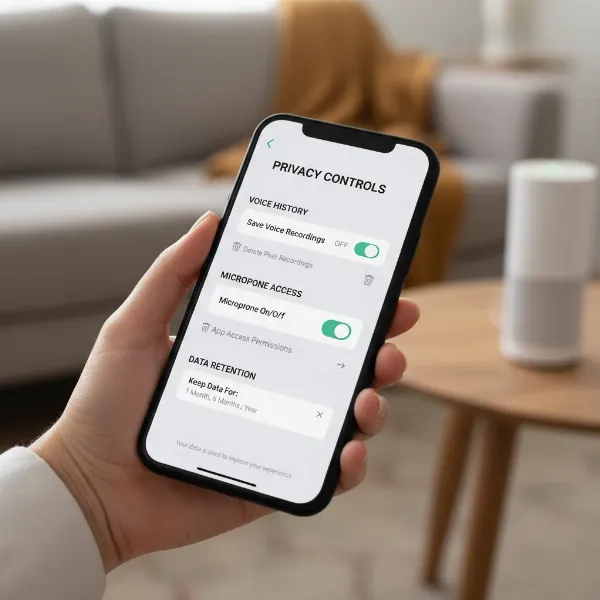 A hand navigating privacy settings on a smartphone app for a smart speaker, illustrating user control over data and privacy.
The Balancing Act: Convenience vs. Privacy
Ultimately, owning a smart speaker involves a balancing act between the undeniable convenience they offer and your personal privacy preferences. For many, the benefits of instant access to information, smart home control, and entertainment outweigh the perceived privacy risks. However, this doesn’t mean you should ignore privacy concerns. By being informed about how these devices work and actively utilizing the available privacy controls, you can tailor your smart speaker experience to fit your comfort level. It’s about making an informed choice, not an all-or-nothing decision.
Conclusion
The myth that smart speakers are always secretly recording your every word is largely unfounded. While they are indeed “always listening” for a wake word in a local, passive state, they only actively record and transmit audio to the cloud once triggered. However, the potential for accidental activations, the collection of voice data, and security vulnerabilities underscore the need for vigilance. By understanding how smart speakers operate and proactively managing your privacy settings—from utilizing mute buttons to regularly deleting voice history—you can debunk these myths and take charge of your digital footprint. Embrace the convenience, but do so with an informed and empowered approach to your privacy. What steps will you take today to enhance your smart speaker privacy?
Frequently Asked Questions
Can my smart speaker listen to my private conversations without the wake word?
No, smart speakers are designed to only process and record audio after detecting their specific wake word (e.g., “Alexa,” “Hey Google,” “Hey Siri”). They operate in a passive, local listening mode for the wake word, but do not record or transmit private conversations to the cloud without being activated.
Do smart speakers record everything I say?
Smart speakers do not record “everything” you say. They record commands given after the wake word is detected. Companies like Amazon, Google, and Apple have different policies regarding the storage duration of these recordings, with some offering options for users to review and delete them.
Can smart speakers be hacked for continuous eavesdropping?
While unlikely for the average user, smart speakers, like any internet-connected device, can be vulnerable to sophisticated hacking attempts. If a device’s core software is compromised, it could theoretically be modified to record continuously. Keeping software updated and managing network security is crucial.
How often should I check my smart speaker’s privacy settings?
It’s a good practice to review your Smart Speaker’s privacy settings and voice history at least once every few months, or whenever there’s a significant software update or a change in your household’s usage. This ensures your preferences are maintained and you stay informed about any new privacy features.
What is the best smart speaker for privacy?
Apple’s HomePod is often cited for its stronger privacy protections, largely due to its emphasis on on-device processing and anonymization of data sent to servers. However, all major brands offer robust privacy controls that, when actively managed by the user, can significantly enhance data protection.