That moment of panic when your phone vanishes into thin air can be unsettling. Whether it slipped between couch cushions, disappeared under a pile of laundry, or simply decided to play hide-and-seek, the feeling of helplessness is universal. But what if you could simply ask for help and have your phone reveal its location with a loud ring? Thanks to the power of Google Assistant and your trusty smart speaker, that convenience is now a reality. This guide will walk you through the seamless process of leveraging your smart devices to pinpoint your lost phone, turning frustration into a swift recovery.
Leveraging Smart Speakers with Google Assistant to Find Your Phone
Smart speakers have become central to modern smart homes, offering hands-free control and instant access to a wealth of information. Their always-on, voice-activated nature makes them an invaluable tool when you need to find a misplaced device quickly.
What Makes Smart Speakers Ideal for Finding Lost Devices?
|
Our Picks for the Best Smart Speaker in 2026
As an Amazon Associate I earn from qualifying purchases.
|
||
| Num | Product | Action |
|---|---|---|
| 1 | Mini Bluetooth Speaker, Smart Wireless Portable Speaker with Touchscreen, Loud HD Sound, LED Lights, BT5.4, All In One Small Audio for Home/Outdoor/Travel/Shower/Party/Beach/Camping/Hiking/Cycling |

|
| 2 | Bluetooth Speaker with HD Sound, Portable Wireless, IPX5 Waterproof, Up to 20H Playtime, TWS Pairing, BT5.3, for Home/Party/Outdoor/Beach, Electronic Gadgets, Birthday Gift (Black) |
|
| 3 | Portable Bluetooth Speaker Valentines Gifts For Him: Powerful Crystal Clear Sound/Romantic Light/IPX5 Waterproof/All Day Playtime/BT 5.3/TWS Paring,Small Wireless Speaker for Outdoor-Travel-Date Night |
|
| 4 | aowoka Bluetooth Speaker, 2025 Portable Wireless Speakers with Led Light, Bluetooth 5.4, 24H Playtime, Enhanced Bass, IPX7 Waterproof, Outdoor Speaker for Travel, Sport, Party, Biking. |
|
| 5 | WiiM Sound Lite Smart Speaker, Hi‑Res 24‑bit/192 kHz, AI RoomFit™ Room Correction, 100W Peak, Wi‑Fi 6E/Bluetooth 5.3, Multi‑Room & Stereo Pairing, Black |
|
| 6 | Bluetooth Speaker with HD Sound and Lights, Portable Wireless, Long-lasting battery life, TWS Pairing, for Home/Party/Outdoor/Travel/Beach, Stocking Stuffers, White Elephant Gifts for Adults (Black) |
|
| 7 | Belkin SOUNDFORM Elite Hi-Fi Smart Speaker + Wireless Charger (Alexa Voice-Controlled Bluetooth Speaker) Sound Technology By Devialet, Fast Wireless Charging for iPhone, Samsung Galaxy & More - White |
|
| 8 | Sonos Era 100 - White - Wireless, Alexa Enabled Smart Speaker |
|
| 9 | Google Audio Bluetooth Speaker - Wireless Music Streaming, Powerful Sound, Assistant Built-in, Wi-Fi and Bluetooth Connectivity, Smart Home Control, Stereo Pairing - Chalk |
|
| 10 | Sony SRS-XB100 Wireless Bluetooth Portable Lightweight Super-Compact Travel Speaker, Durable IP67 Waterproof & Dustproof Shower Speaker, 16 Hour Battery, Versatile Strap, & Hands-free Calling, Black |
|
Smart speakers provide a hands-free solution when your phone is out of reach or sight. Unlike your phone, these devices are typically plugged in and constantly connected to your home network, making them always ready to receive commands. Their strategic placement throughout a home also means you often have a Google Assistant-enabled device within earshot.
Google Assistant: Your Digital Lifeline
Google Assistant is an artificial intelligence-powered virtual assistant, developed by Google, that is available on various devices, including smart speakers, smartphones, and smart displays. It allows users to interact through natural language conversations, commanding their devices or asking questions. Its capability to integrate with Google’s “Find My Device” service makes it a powerful ally in locating a missing phone. From its early days, Google Assistant has evolved to seamlessly manage an array of tasks, offering a critical link when your phone decides to go rogue.
Key Smart Speaker Brands with Google Assistant
Many popular smart speaker brands integrate Google Assistant, making them perfect for finding your phone. Google’s own Nest speakers and displays, like the Nest Mini and Nest Hub, are prime examples, offering deep integration with Google services. Beyond Google’s hardware, other manufacturers such as JBL and Lenovo also produce smart speakers and displays that feature Google Assistant, ensuring a wide array of options for users.
Step-by-Step Guide: Using Google Assistant to Locate Your Phone
Finding your phone with Google Assistant is surprisingly straightforward, but a few crucial preparations ensure the process works smoothly every time. Setting up your phone correctly beforehand is like having an emergency beacon ready to activate.
Preparing Your Phone for Easy Retrieval
Before you can rely on Google Assistant, ensure your phone is properly configured. First and foremost, your lost phone must be powered on and connected to either mobile data or Wi-Fi. It also needs to be signed in to the same Google Account that your Google Assistant device uses. Most critically, Google’s “Find My Device” feature, or “Find Hub” on newer Android versions, must be enabled on your phone. This setting is typically activated by default, but it is always wise to double-check in your phone’s security settings.
> “The true magic of smart assistants isn’t just convenience; it’s about providing immediate solutions to common dilemmas, like finding a phone that’s seemingly vanished into thin air.” – Dr. Evelyn Reed, Smart Home Technology Analyst
Simple Voice Commands That Save the Day
When panic strikes, remember these simple phrases. Activate your Google Assistant on a smart speaker or another phone by saying, “Hey Google.” Then, try one of these commands:
- “Find my phone.”
- “Where is my phone?”
- “Ring my phone.”
If you have multiple Android devices linked to your Google Account, you might need to be more specific. For example, say, “Hey Google, find my Pixel” or “Ring my Samsung tablet” to target the correct device. This clarity ensures only the desired phone begins to ring, preventing confusion.
What Happens When You Ask?
Once Google Assistant receives your command, it sends a signal to your lost phone via the “Find My Device” service. Your phone will then ring at its maximum volume for about five minutes, making it much easier to hear, even if it was previously set to silent or Do Not Disturb mode. This loud, persistent ring is often enough to reveal its hiding spot, whether it’s under a cushion or tucked away in a forgotten corner.
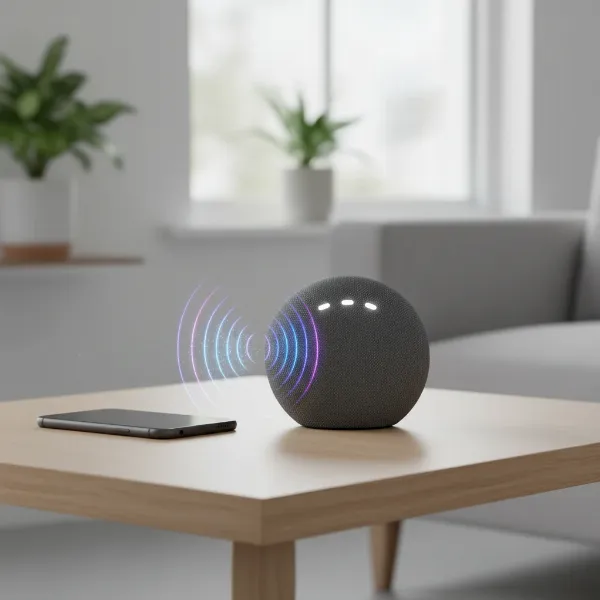 A Google Nest Mini smart speaker on a table ringing a smartphone with sound waves
Advanced Tips and Troubleshooting for Finding Your Device
Sometimes a simple ring isn’t enough, or your phone might be truly lost outside the home. In these situations, Google’s robust “Find Hub” (previously known as “Find My Device”) offers a suite of more advanced tools.
Beyond the Ring: Using Google’s Find Hub
Google’s Find Hub provides a comprehensive solution for managing and locating your Android devices. You can access it directly via a web browser at android.com/find or by downloading the dedicated Find Hub app on another device. This platform offers several powerful features:
- Mapping Location: See your phone’s last known location on a map, which is incredibly useful if you suspect it was lost outside your home.
- Play Sound: Re-trigger the loud ringing sound, similar to the Google Assistant command, if you’re near the location shown on the map.
- Secure Device: If your phone is missing and unsecured, you can remotely lock it with a PIN, pattern, or password. You can also display a contact message or phone number on the lock screen, hoping a good Samaritan finds and returns it.
- Erase Device: As a last resort, if you believe your phone is stolen and irretrievable, you can remotely erase all data. This protects your personal information but note that once erased, you can no longer locate the device.
- Find Nearby: For those times when your device is close but still out of sight, this feature helps pinpoint its exact location by guiding you with visual cues as you get closer. The Find Hub network, powered by other Android devices, can even help locate your phone when it’s offline if it runs Android 9 or above.
When Google Assistant Can’t Find Your Phone
There are a few scenarios where Google Assistant might not be able to locate your phone. If your phone is out of battery, completely powered off, or disconnected from the internet, it won’t be able to receive the signal to ring. Similarly, if you haven’t signed into a Google Account on the device or if the “Find My Device” setting has been disabled, Google Assistant will be unable to help. For iPhone users, while Google Nest devices can be asked to ring an iPhone, the iPhone must be configured to work with Google’s Find My Device network, or you’d typically use Apple’s “Find My” service via Siri on an Apple device.
Essential Settings for Future Phone Finding
To ensure you’re always prepared, periodically verify that your “Find My Device” settings are active. Keep your location services enabled on your phone and consider turning on “Find offline devices” if your phone runs Android 9 or newer, as this leverages a network of Android devices to locate your phone even without an active internet connection. For an added layer of security, implement 2-Step Verification on your Google Account.
Comparison: Google Assistant vs. Other Methods
When it comes to finding a lost phone, you have a few options. Understanding the strengths and weaknesses of each can help you choose the best approach for your specific situation.
| Method | Pros | Cons | Use Case |
|---|---|---|---|
| Google Assistant (via Smart Speaker) | Hands-free, loud ring, works on silent/Do Not Disturb, quick at home | Requires a Google Assistant device nearby, no map tracking directly | Phone misplaced within the house, quick retrieval |
| Find Hub / Find My Device App/Web | Map location, remote lock/erase, “Find nearby” feature, works globally | Requires another device/computer, internet connection on lost phone (mostly) | Phone lost outside the home, stolen, or very well hidden |
| Calling from Another Phone | Simple, works with any phone (if you have another phone) | Only rings if ringer is on, no location tracking, no remote lock/erase | Simple misplacement at home, easily heard |
Maintenance Tips for Your Smart Speaker and Phone
Keeping your devices in top shape not only ensures they function optimally but also maximizes their utility, especially when it comes to critical features like phone finding.
Optimal Smart Speaker Placement
For your Google Assistant to be most effective, place your smart speaker in a central location within your home or in rooms where you frequently use your phone. This ensures your voice commands are clearly heard and received, allowing for quick action when you need to find your device. Avoid placing it in noisy areas or too close to walls, which can sometimes interfere with microphone performance.
Software Updates
Regularly updating the software on both your smart speaker and your smartphone is crucial. Updates often include bug fixes, security enhancements, and improvements to features like voice recognition and device location services. Keeping your devices current ensures you have access to the most reliable and efficient phone-finding capabilities.
Regular Phone Backups
While finding your phone is the immediate goal, protecting your data is paramount. Regularly backing up your phone ensures that even in the unfortunate event of a permanent loss or theft, your precious photos, contacts, and documents are safe. This proactive step can alleviate significant stress, knowing your digital life is secure.
Conclusion
Losing your phone is a common frustration, but it doesn’t have to lead to prolonged stress. With Google Assistant and your smart speaker, you have a powerful, hands-free tool at your disposal to locate your device quickly and efficiently. By understanding simple voice commands and ensuring your phone’s settings are properly configured for Google’s Find Hub, you can regain peace of mind almost instantly. This integration of smart technology into our daily lives truly offers practical solutions to everyday problems, transforming a potential crisis into a minor inconvenience. So, have you checked your “Find My Device” settings recently? Setting them up today can save you a world of trouble tomorrow.
Frequently Asked Questions
Can Google Assistant find my iPhone?
Yes, Google Nest devices with Google Assistant can be asked to ring your iPhone if it is signed into the same Google Account and compatible with the Find My Device network. However, Apple’s own “Find My” service is typically the primary solution for iPhones.
Does it work if my phone is on silent or Do Not Disturb?
Absolutely. One of the best features of using Google Assistant to find your phone is that it will ring at full volume, overriding silent mode or Do Not Disturb settings, making it much easier to hear.
What if my phone is turned off or has no battery?
Unfortunately, if your phone is completely powered off or has no battery, Google Assistant cannot send a signal to make it ring. However, Google’s Find Hub may still show its last known location before it powered down if you have “Find offline devices” enabled on Android 9+.
Do I need a smart speaker for this feature to work?
No, while a Smart Speaker is highly convenient for hands-free searching, you can also use Google Assistant on another Android phone or smart display, or even access Find Hub directly via a web browser on a computer.
How accurate is the location feature through Find Hub?
The accuracy of the location feature on Find Hub varies. It can pinpoint your device’s location quite precisely on a map if GPS is active and it has a strong internet connection. For indoor finding, the “Find nearby” feature offers closer proximity guidance.