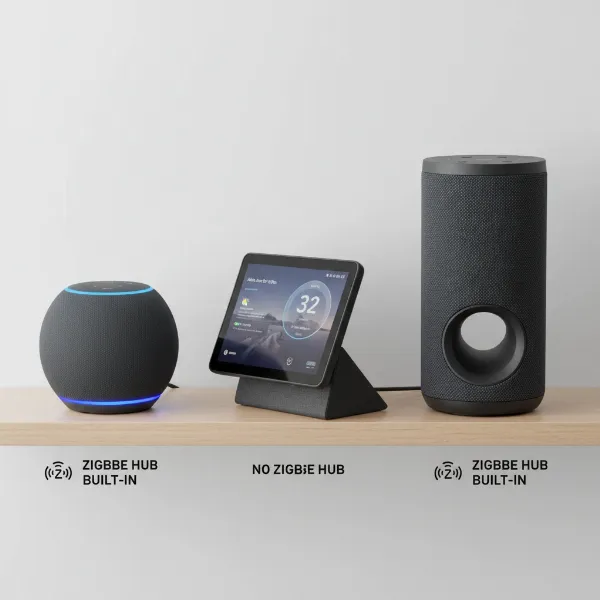
Few things are more frustrating than your smart speaker suddenly refusing to cooperate, especially when it greets you with the unhelpful phrase, “Something went wrong.” If your Google Home or Nest device has started uttering these words instead of fulfilling your commands, you’re not alone. This common hiccup can disrupt your smart home experience, leaving you wondering why your intelligent assistant has suddenly lost its way.
This comprehensive guide is designed by a smart speaker technician with over a decade of experience to help you diagnose and resolve the “Something Went Wrong” error on your Google Home devices. We’ll walk you through simple reboots, delve into network intricacies, and explore software solutions to get your smart assistant back on track, seamlessly integrating with your daily life once more.
Understanding the “Something Went Wrong” Error
When your Google Home speaker reports, “Something went wrong,” it’s a generic message indicating a failure in processing a request or maintaining its normal operation. This isn’t a specific error code but rather a general alert that the device encountered an unexpected issue and couldn’t complete the action you asked for.
What Does This Error Mean and How Does It Operate?
|
Our Picks for the Best Smart Speaker in 2026
As an Amazon Associate I earn from qualifying purchases.
|
||
| Num | Product | Action |
|---|---|---|
| 1 | Sony SRS-XB100 Wireless Bluetooth Portable Lightweight Super-Compact Travel Speaker, Durable IP67 Waterproof & Dustproof Shower Speaker, 16 Hour Battery, Versatile Strap, & Hands-free Calling, Black |

|
| 2 | Belkin SOUNDFORM Elite Hi-Fi Smart Speaker + Wireless Charger (Alexa Voice-Controlled Bluetooth Speaker) Sound Technology By Devialet, Fast Wireless Charging for iPhone, Samsung Galaxy & More - White |
|
| 3 | Portable Bluetooth Speaker Valentines Gifts For Him: Powerful Crystal Clear Sound/Romantic Light/IPX5 Waterproof/All Day Playtime/BT 5.3/TWS Paring,Small Wireless Speaker for Outdoor-Travel-Date Night |
|
| 4 | Bluetooth Speaker with HD Sound, Portable Wireless, IPX5 Waterproof, Up to 20H Playtime, TWS Pairing, BT5.3, for Home/Party/Outdoor/Beach, Electronic Gadgets, Birthday Gift (Black) |
|
| 5 | Mini Bluetooth Speaker, Smart Wireless Portable Speaker with Touchscreen, Loud HD Sound, LED Lights, BT5.4, All In One Small Audio for Home/Outdoor/Travel/Shower/Party/Beach/Camping/Hiking/Cycling |
|
| 6 | Google Audio Bluetooth Speaker - Wireless Music Streaming, Powerful Sound, Assistant Built-in, Wi-Fi and Bluetooth Connectivity, Smart Home Control, Stereo Pairing - Chalk |
|
| 7 | aowoka Bluetooth Speaker, 2025 Portable Wireless Speakers with Led Light, Bluetooth 5.4, 24H Playtime, Enhanced Bass, IPX7 Waterproof, Outdoor Speaker for Travel, Sport, Party, Biking. |
|
| 8 | Bluetooth Speaker with HD Sound and Lights, Portable Wireless, Long-lasting battery life, TWS Pairing, for Home/Party/Outdoor/Travel/Beach, Stocking Stuffers, White Elephant Gifts for Adults (Black) |
|
| 9 | WiiM Sound Lite Smart Speaker, Hi‑Res 24‑bit/192 kHz, AI RoomFit™ Room Correction, 100W Peak, Wi‑Fi 6E/Bluetooth 5.3, Multi‑Room & Stereo Pairing, Black |
|
| 10 | Sonos Era 100 - White - Wireless, Alexa Enabled Smart Speaker |
|
Essentially, your Google Home device relies on a complex chain of connectivity and software processes to function. It needs to hear your command, process it locally, send it to Google’s servers via your Wi-Fi network, receive a response, and then execute an action or deliver information. A breakdown at any point in this chain can trigger the “Something Went Wrong” message. It’s a catch-all phrase that often points to underlying connectivity, software glitches, or sometimes even hardware issues like a blocked microphone.
A Brief History of Smart Speaker Development
From the early days of Amazon Echo to the rise of Google Home, smart speakers have rapidly evolved, offering ever-increasing capabilities. While the technology has made incredible strides, these complex systems are still susceptible to occasional software bugs, network dropouts, or compatibility challenges, leading to common troubleshooting scenarios like this error message. Manufacturers continuously release updates to enhance performance and stability, but user intervention is sometimes necessary for persistent issues.
Prominent Smart Speaker Brands and Their Ecosystems
While Google Home (now primarily branded as Google Nest) is at the heart of this troubleshooting guide, it’s part of a broader smart speaker landscape. Key players include Amazon with its Echo line (Alexa), Apple with HomePod (Siri), and Sonos, which integrates with both Alexa and Google Assistant. Each ecosystem has its unique architecture, but fundamental troubleshooting principles, particularly concerning network connectivity, remain universal across these platforms.
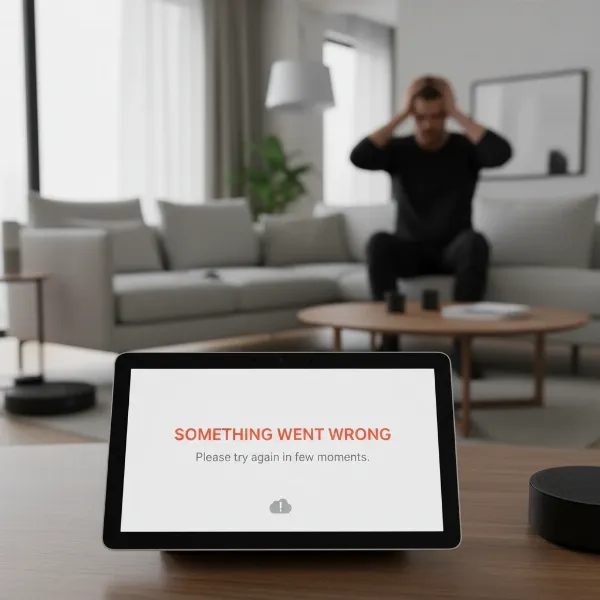 Google Home screen displaying 'Something Went Wrong' error message with a frustrated user in the background
Common Causes of the Google Home “Something Went Wrong” Error
Several factors can contribute to your Google Home device displaying the “Something Went Wrong” error. Understanding these common culprits is the first step toward effectively resolving the issue. By identifying the root cause, you can target your troubleshooting efforts more precisely.
Connectivity and Network Issues
The most frequent reason for this error is a problem with your internet connection or local Wi-Fi network. Google Home devices are highly reliant on a stable and fast connection to communicate with Google’s servers. If the Wi-Fi signal is weak, intermittent, or your router is experiencing issues, the device simply cannot perform its functions. Network congestion, incorrect Wi-Fi band usage (e.g., 2.4 GHz vs. 5 GHz), or even a temporary DNS problem can all lead to communication failures.
Software Glitches and Outdated Firmware
Like any electronic device, Google Home speakers run on software that occasionally encounters bugs or requires updates. An outdated Google Home app on your smartphone, or an older firmware version on the Google Home device itself, can lead to compatibility issues and unexpected errors. These software-related problems can sometimes manifest as a general “Something Went Wrong” message. Ensuring all your software is current is a crucial preventative measure.
Microphone and Voice Recognition Problems
Less common but still possible are issues with the device’s ability to hear or correctly interpret your commands. If the microphone ports are blocked by dust or debris, or if there’s excessive background noise, the device might fail to pick up your voice or understand what you’re saying, leading to a “Something Went Wrong” response. While the error is generic, it might subtly indicate a failure in the initial command reception.
> “Often, the ‘Something Went Wrong’ error is a symptom, not the disease. It’s Google Home’s way of saying, ‘I tried, but something in my communication chain broke down.’ Always start by looking at your network.” – Alex Chen, Smart Speaker Network Specialist
Initial Troubleshooting Steps (Quick Fixes)
Before diving into more complex solutions, let’s tackle the most common and easiest fixes. These steps often resolve the “Something Went Wrong” error quickly, saving you time and effort. It’s always best to start with the simplest solutions first, as they frequently address temporary glitches.
Reboot Your Google Home Device
A simple reboot can work wonders, much like restarting a computer. It clears temporary bugs and re-establishes connections. To perform a hard reboot, unplug the power cord from your Google Home or Nest device. Wait for at least 60 seconds. Then, plug the power cord back in. Allow the device a few minutes to restart and reconnect to your Wi-Fi network. You’ll see its lights appear on top, and an audible chime will confirm it’s ready.
Restart Your Router and Modem
Since connectivity is a primary culprit, rebooting your internet equipment is a crucial step. Unplug your Wi-Fi router and your modem from their power outlets. Wait for about 30-60 seconds. Plug the modem back in first, wait for its indicator lights to stabilize (usually a minute or two), then plug your router back in. Allow your router to fully boot up and re-establish your network before testing your Google Home device. This ensures a fresh, stable internet connection for all your devices.
Check Wi-Fi Connection and Signal Strength
Ensure your Google Home device is receiving a strong Wi-Fi signal. If it’s too far from your router, the connection can be weak and unreliable. Try moving your Google Home speaker closer to the Wi-Fi router, ideally within 15-20 feet (4-6 meters). Additionally, if you have a dual-band router, consider whether your Google Home is on the appropriate band. While many devices can use 5GHz, sometimes the 2.4GHz band offers better range and penetration through walls.
Verify Google Home App is Updated and Restarted
Your Google Home app on your smartphone or tablet acts as a vital control center. Make sure you’re running the latest version of the app by checking your device’s app store for any available updates. After updating (or if it’s already current), restart the Google Home app itself. On Android, swipe up from the bottom, hold, then swipe up on the app to close it. On iOS, swipe up from the bottom and swipe up on the app preview. Reopen the app and test your Google Home.
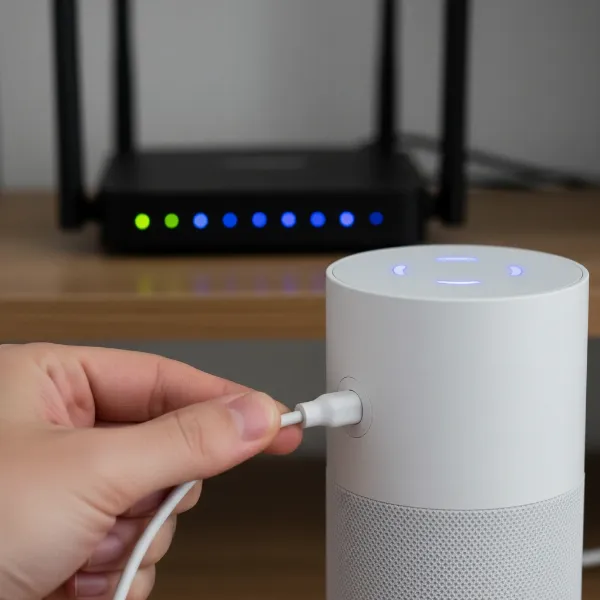 Hand unplugging a Google Home speaker with a Wi-Fi router in the background
Advanced Troubleshooting Techniques
If the quick fixes didn’t resolve the “Something Went Wrong” error, it’s time to dig a little deeper. These advanced steps address less common but often effective solutions, tackling underlying software or network configurations that might be causing the problem.
Checking Phone/Tablet Settings
The device you use to control your Google Home can influence its performance. Ensure that Wi-Fi, Location Services, and Bluetooth are all turned ON on your phone or tablet. Crucially, turn OFF mobile/cellular data on your phone. Sometimes, your phone tries to use cellular data even when connected to Wi-Fi, creating a conflict that can interfere with the setup or stable operation of your Google Home. Also, temporarily disable any VPNs or Apple Private Relay features, as these can sometimes interfere with network communication.
Clearing Google App Cache and Data
Over time, cached data and app data can become corrupted, leading to performance issues. Clearing the cache and data for the Google app (which Google Assistant relies on) can resolve these conflicts.
- On Android: Go to Settings > Apps > Google App (or Google Assistant) > Storage > Clear Cache and then Clear Data.
- On iOS: You may need to uninstall and reinstall the Google Home app to clear its data effectively.
Remember, clearing data will require you to sign back into the app.
Addressing Potential Interference and Network Configuration
Physical interference from other electronics can degrade your Wi-Fi signal. Try moving your Google Home speaker away from devices that operate on similar frequencies, such as microwave ovens, cordless phones, baby monitors, or other wireless speakers. These devices can cause signal interference that disrupts your Google Home’s connection.
A less common but sometimes effective solution involves your router’s IPv6 settings. Some users have reported resolving the “Something Went Wrong” error by disabling IPv6 on their router and solely using IPv4. This is a more technical adjustment and should only be attempted if you are comfortable accessing your router’s settings. Consult your router’s manual or ISP for specific instructions on how to do this, as it can affect all devices on your network.
Checking for Microphone Obstructions
While the error usually points to connectivity, sometimes the problem lies in your Google Home’s ability to hear you. Take a moment to inspect the microphone ports on your device. Dust or debris can accumulate in these tiny openings, preventing your voice commands from being detected properly. Use a dry Q-tip to carefully clean these areas. Gently tapping the device on a soft surface can also help dislodge any hidden particles inside. Keeping these ports clear is vital for optimal voice recognition.
When All Else Fails: Factory Reset and Support
If you’ve systematically worked through all the previous troubleshooting steps and your Google Home device still reports, “Something went wrong,” it might be time for a factory reset. This is a last-resort measure that erases all personal data and settings, returning the device to its out-of-the-box state.
Guide to Factory Resetting Your Google Home
A factory reset should be considered when all other solutions have failed, as it requires you to set up your device again from scratch. The exact method varies slightly by model, but generally involves:
- Locate the Reset Button: On most Google Home devices, this is a small button on the back or bottom of the unit, often near the power cord. For some models, it might be a microphone mute button that doubles as a reset button (e.g., Google Home Mini).
- Press and Hold: Press and hold the reset button for 10-15 seconds. You’ll usually hear a confirmation message and see the lights change, indicating the reset process has begun.
- Re-setup: Once the device has reset and rebooted, you’ll need to use the Google Home app on your smartphone or tablet to set it up again as if it were a new device.
When to Contact Google Support
If even a factory reset doesn’t resolve the “Something Went Wrong” error, or if you suspect a hardware malfunction, it’s time to contact Google’s official support. They can offer more specific diagnostics, provide warranty assistance, or recommend repair/replacement options. Be prepared to describe the troubleshooting steps you’ve already taken, as this will help them narrow down the potential issues more quickly.
Common Issues & Quick Solutions Table
| Model | Common Issue Leading to “Something Went Wrong” | Quick Fix |
|---|---|---|
| Google Home / Nest Hub (All models) | Intermittent Wi-Fi connection | Reboot router & Google Home device |
| Google Home Mini / Nest Mini | Outdated Google Home app or firmware | Update Google Home app, clear app cache |
| Any Google Home Device | Microphone not picking up commands | Clean microphone ports with a dry Q-tip |
| Google Home / Nest Hub (All models) | Network congestion or IP conflict | Disable mobile data on phone, temporarily disable IPv6 on router |
| Any Google Home Device | Temporary software glitch | Hard reboot Google Home (unplug for 60 seconds) |
Tips for Preventing Future Google Home Errors
While troubleshooting is essential when an issue arises, adopting good practices can significantly reduce the likelihood of encountering the “Something Went Wrong” error in the first place. Proactive maintenance ensures your smart speaker ecosystem runs smoothly.
Keep Software and Firmware Updated
Regularly check for and install updates for both your Google Home app and your Google Home/Nest device’s firmware. These updates often include bug fixes, performance enhancements, and security improvements that can prevent common errors. Enabling automatic updates for the Google Home app on your phone is a good habit.
Maintain Good Network Health
A stable and robust Wi-Fi network is the backbone of your smart home. Periodically reboot your router and modem to refresh network connections. Ensure your Google Home device is placed within optimal range of your Wi-Fi router, avoiding dead zones or areas with significant interference. Consider using a Wi-Fi analyzer app to check signal strength around your devices. If you have a dual-band router, ensure your device is connected to the band that offers the best performance for its location.
Optimal Device Placement
Where you place your Google Home device matters more than you might think. Beyond Wi-Fi signal strength, consider potential sources of electrical interference. Placing your smart speaker away from large metal objects, other wireless transmitters, or appliances that emit electromagnetic interference can improve its stability and responsiveness. Good placement also helps the microphones pick up your voice commands clearly, reducing misinterpretations that could lead to errors.
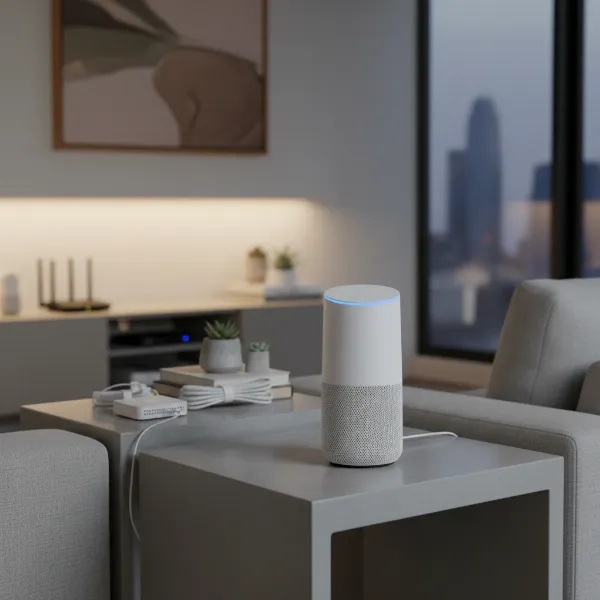 A Google Home speaker in a clean, modern living room with visible, tidy network cables/router
Conclusion
Encountering the “Something Went Wrong” error on your Google Home device can be a frustrating experience, but it’s rarely a sign of irreparable damage. By systematically addressing common causes, from simple reboots to optimizing network settings and ensuring software is up-to-date, you can typically restore your smart assistant to full functionality. Remember to approach troubleshooting methodically, starting with the easiest fixes and progressing to more advanced solutions when necessary.
A reliable Google Home is central to a convenient smart living experience. With the right knowledge and a bit of patience, you can overcome these common hurdles and continue to enjoy the seamless control and assistance your Smart Speaker provides. What’s the most unusual fix you’ve discovered for a persistent smart home glitch?
Frequently Asked Questions
Why does my Google Home keep saying “Something went wrong, try again”?
This generic message often indicates a temporary communication breakdown. The most common causes are Wi-Fi connectivity issues, a temporary software glitch on the device, or an outdated Google Home app. Starting with a simple reboot of both your Google Home and your Wi-Fi router often resolves this issue quickly.
How do I fix a Google Home that isn’t responding to voice commands?
If your Google Home isn’t responding, first ensure the microphone isn’t muted (check for a physical button) and that its ports are clear of debris. Then, check your internet connection and reboot the device. Sometimes, restarting the Google Home app on your phone can also help restore responsiveness.
Can outdated software cause Google Home errors?
Yes, absolutely. Outdated firmware on your Google Home device or an old version of the Google Home app on your smartphone can lead to compatibility issues and various errors, including the “Something Went Wrong” message. Regularly updating all software components is crucial for optimal performance and stability.
What role does my Wi-Fi router play in Google Home errors?
Your Wi-Fi router is critical. It provides the internet connection your Google Home needs to communicate with Google’s servers. Issues like a weak signal, network congestion, incorrect band usage (2.4GHz vs. 5GHz), or even specific router settings like IPv6 configuration can directly cause connectivity errors that manifest as “Something Went Wrong.”
Is a factory reset always the solution for Google Home problems?
A factory reset is a powerful tool but should be considered a last resort. It clears all data and settings, requiring a complete re-setup. Before resorting to a factory reset, always try basic troubleshooting steps like rebooting, checking network connections, and updating software, as these often resolve the issue without data loss.