In an increasingly connected world, voice assistants have seamlessly integrated into our daily lives, transforming how we interact with technology. From setting alarms and playing music to managing smart homes and answering complex queries, these intelligent companions have become indispensable. Yet, with Amazon Alexa, Google Assistant, and Apple Siri dominating the market, choosing the right digital helper can feel like navigating a maze. Each boasts unique strengths and deep integrations, making the “ultimate voice test” a personal journey.
This comprehensive guide will meticulously compare Alexa, Google Assistant, and Siri across key performance areas, helping you understand their nuances and empowering you to select the smart assistant that perfectly aligns with your lifestyle and ecosystem. Prepare to put these digital titans head-to-head and discover which voice truly deserves a place in your home.
Understanding the Major Voice Assistants
Before diving into the intricate comparisons, it is essential to grasp what voice assistants are and how they function, along with their journey to omnipresence. These aren’t just advanced speakers; they are complex software systems designed to simplify your digital interactions.
What are Voice Assistants and How Do They Work?
At their core, voice assistants are software agents that can perform tasks or services for an individual based on commands or questions. They function through a sophisticated process: first, they convert spoken language into text using automatic speech recognition (ASR). Next, natural language understanding (NLU) processes this text to discern the user’s intent and extract relevant information. Finally, they execute the requested action, whether it is retrieving information, controlling a device, or initiating a communication. While incredibly advanced, it’s crucial to remember that they are execution layers built to convert spoken intent into predefined actions, rather than truly “thinking systems” capable of open-ended reasoning.
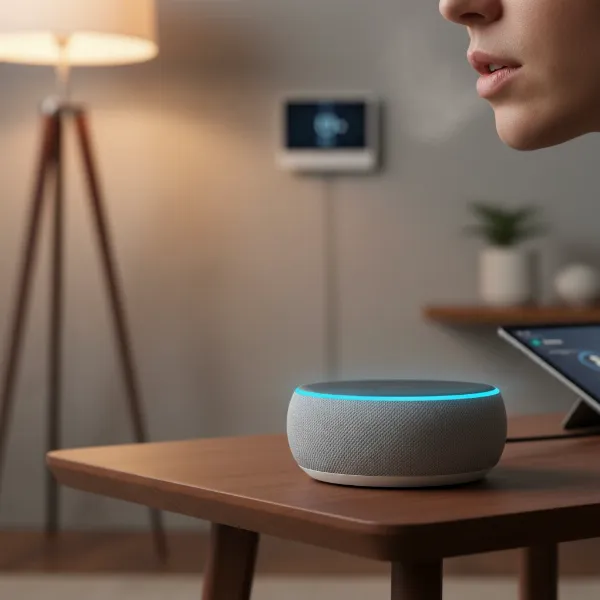 A smart speaker interacting with a user, illustrating voice assistant technology and home integration.
A Brief History of Voice Assistants
The concept of voice interaction with technology dates back decades, but the modern era of consumer-grade voice assistants truly began with the introduction of Apple’s Siri in 2011, initially on the iPhone 4S. This marked a significant shift, bringing conversational AI to millions of pockets. Amazon followed in 2014 with Alexa, embedded in its Echo Smart Speaker, pioneering the dedicated smart home assistant. Google Assistant emerged in 2016, leveraging Google’s vast search and AI capabilities to offer a powerful, context-aware experience. Over the years, these platforms have rapidly evolved, moving beyond simple commands to offer more contextual awareness, handle follow-up questions, and integrate deeper into various facets of our digital and physical environments.
Key Players: Amazon Alexa, Google Assistant, and Apple Siri
These three giants represent distinct philosophies in the voice assistant landscape. Amazon Alexa is renowned for its extensive smart home compatibility and vast “Skills” ecosystem, making it a favorite for those looking to automate their residences. Google Assistant, backed by the world’s leading search engine, excels in providing accurate, context-rich information and seamless integration with Google’s suite of services. Apple Siri distinguishes itself with a strong emphasis on user privacy, on-device processing, and unparalleled integration within Apple’s proprietary hardware and software ecosystem. Each offers a unique blend of features designed to cater to different user priorities and existing technological allegiances.
Deep Dive: Comparing Alexa, Google Assistant, and Siri
Understanding the general landscape is one thing, but a true test comes from comparing how these assistants perform in everyday scenarios. From simple commands to complex routines, their differences become clear.
Core Capabilities: From Basic Commands to Complex Routines
All three voice assistants handle fundamental tasks with ease. Setting alarms, playing music, initiating calls, sending messages, and answering basic factual questions are core competencies across the board. However, their execution and robustness vary when faced with more complex or multi-step requests.
Google Assistant, for instance, is often cited as the leader in understanding contextual and follow-up questions, seamlessly continuing a conversation without needing the user to rephrase or repeat information. Alexa excels in smart home automation, offering robust routines with “if” and “when” building blocks, making complex sequences of actions relatively easy to set up for a connected home. Siri, particularly with recent advancements like Apple Intelligence, has improved its ability to understand conversational queries and manage communication tasks efficiently, although its scope is primarily confined to the Apple ecosystem. While all can set a timer or play a song, the fluidity and success rate for more intricate tasks can differ significantly.
Ecosystem Integration and Smart Home Control
The effectiveness of a voice assistant often hinges on how well it integrates with your existing devices and smart home setup. This is where the distinct strategies of Amazon, Google, and Apple truly shine.
- Amazon Alexa stands out as the powerhouse for smart home enthusiasts. It boasts the widest support for third-party smart home devices, allowing users to connect and control an incredibly diverse range of products. From smart lights and thermostats to security cameras and robot vacuums, Alexa’s broad compatibility and flexible routine creation make it an ideal choice for a heavily automated home. Its Matter support further enhances integration, simplifying connectivity across different brands.
- Google Assistant offers strong smart home capabilities, especially within its own ecosystem of Google Home and Nest products. Its integration with Google’s services means it can pull personalized information, like calendar events or traffic updates, directly into your smart home routines. While its range of directly compatible third-party devices might not be as vast as Alexa’s, it is still very robust, and its advanced AI often makes smart home interactions feel more intuitive and conversational.
- Apple Siri focuses on a highly curated and secure smart home experience through HomeKit-certified devices. While the number of compatible devices is more limited compared to Alexa, HomeKit devices offer seamless integration within the Apple ecosystem, benefiting from on-device processing for enhanced privacy and responsiveness. The arrival of Matter has been particularly beneficial for HomeKit, providing more parity with a wider selection of smart home devices that can now be transferred between platforms. For households fully invested in Apple products, Siri provides a polished, secure, and tightly integrated smart home control.
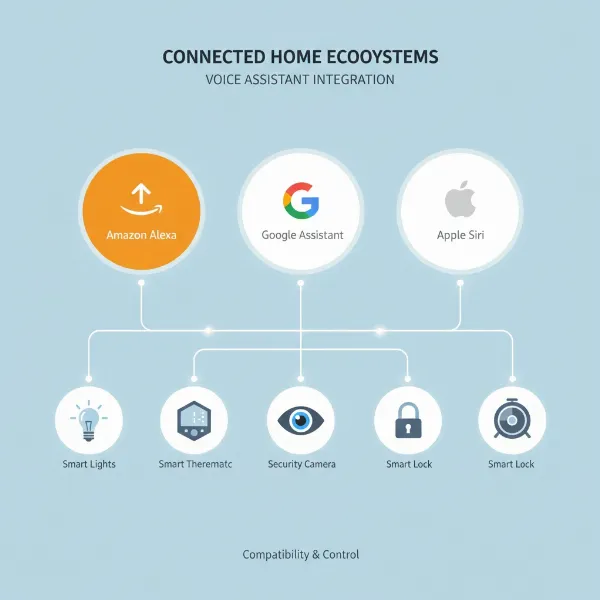 Visual representation of a smart home ecosystem controlled by various voice assistants like Alexa, Google Assistant, and Siri.
Personalization and User Experience
A truly smart assistant adapts to you. The user experience varies greatly among the three, from how they learn your preferences to how they present information.
Google Assistant excels at personalization, offering features like Voice Match to provide tailored responses, calendars, flights, and even payments specific to individual users in a household. Its ability to integrate with Google’s expansive services means it can offer highly personalized music content, news briefings, and even read your emails.
Alexa allows users to expand its capabilities through “Skills,” essentially third-party voice apps that add new functions, from ordering pizza to playing interactive games. It also offers a customizable wake word, giving users a slight edge in personalizing how they address their assistant. While some users report occasional unwanted suggestions or advertisements, Alexa’s core utility for commands and routines remains strong.
Siri offers a seamless experience for those immersed in the Apple ecosystem, with smooth handoffs of content like calls and music between iPhones, iPads, and HomePods. Its improved on-device processing, particularly with Apple Intelligence, ensures that many requests are handled locally, enhancing both speed and privacy. Siri’s personality is often described as precise and direct, though it can sometimes be less conversational than its counterparts.
Accuracy and Natural Language Understanding
Perhaps the most critical aspect of any voice assistant is its ability to accurately understand and respond to queries. This is where the “intelligence” truly comes to the forefront.
In recent analyses, Google Assistant consistently takes the crown for accuracy, particularly for complex search queries and handling contextual or follow-up questions. Leveraging Google’s vast search database and advanced AI, it understands nearly 100% of questions and answers approximately 93% of them correctly. This makes it the top performer for information retrieval and complex research.
Siri has made significant strides in accuracy with iOS 19 and Apple Intelligence. While it may not always match Google Assistant’s depth for general knowledge questions, it shows strong proficiency in understanding conversational queries and managing communication tasks, often performing well in command-based interactions like sending texts or setting calendar events.
Alexa is solid for direct commands and executing routines. However, in some comparative tests, it has lagged behind Google Assistant and Siri in answering complex or less orthodox questions, sometimes struggling with context or occasionally providing less accurate responses. Amazon has continuously worked to improve Alexa’s performance, but it generally remains more focused on execution rather than deep informational retrieval compared to Google Assistant.
Privacy and Security
In an era of increasing digital awareness, privacy and security are paramount considerations when choosing a voice assistant. Each platform approaches these concerns with varying philosophies.
Apple Siri leads the pack in terms of privacy, largely due to Apple’s strong emphasis on on-device processing and a commitment to minimizing data sharing. Many Siri requests are handled directly on your device, reducing the amount of personal information sent to Apple’s servers. This “Apple-first approach” is a significant draw for users who prioritize data security.
Amazon Alexa offers robust security measures, including customizable parental controls and the ability to review and delete voice recordings. Users can manage privacy settings within the Alexa app, deciding how their data is used and stored. While it processes more data in the cloud than Siri, Amazon has invested heavily in security protocols.
Google Assistant also employs strong security measures, leveraging Google’s account-based security infrastructure. Users can manage activity data, choose what information is saved, and set retention limits. Like Alexa, it relies on cloud processing for many of its functions, but Google provides various tools for users to control their privacy settings.
Choosing Your Ideal Voice Assistant: What to Consider
With distinct strengths and focuses, there is no one-size-fits-all “best” voice assistant. Your perfect match depends entirely on your personal needs, existing tech ecosystem, and priorities.
Identifying Your Primary Needs
Start by asking yourself what you primarily want a voice assistant for. Are you looking to:
- Control your smart home? If you have a diverse array of smart devices from different manufacturers, Alexa’s broad compatibility might be your top priority.
- Retrieve information and ask complex questions? Google Assistant’s superior accuracy and contextual understanding make it ideal for fact-finding and detailed inquiries.
- Manage communications and integrate seamlessly with your mobile life? Siri, especially within an Apple-centric household, excels at messaging, calls, and calendar synchronization.
- Simply play music and set timers? All three can handle these basics effectively, opening up choices based on other factors like cost or sound quality.
Ecosystem Lock-in and Device Compatibility
Your existing technology plays a crucial role.
- Apple-only Households: If your life revolves around iPhones, iPads, Apple Watches, and Macs, Siri offers unparalleled, secure integration and is likely your most logical choice.
- Android Users: Google Assistant is deeply embedded within the Android operating system and Google services, making it a natural extension for Android smartphone users.
- Mixed Households or Smart Home Enthusiasts: Alexa offers the most universal platform, playing nicely with a wide variety of devices and both Android and Apple phones, providing flexibility if you don’t adhere strictly to one brand.
Key Factors for Decision Making
When making your final decision, weigh these critical elements:
- Accuracy and Understanding: How often do you need your assistant to answer complex questions or understand nuanced commands? Google Assistant generally leads here.
- Privacy Concerns: If data privacy is your utmost concern, Apple’s Siri, with its emphasis on on-device processing, offers the strongest assurances.
- Voice Recognition and Natural Language Processing: Consider how naturally you want to speak to your assistant. Google Assistant and the improved Siri handle conversational queries very well.
- Third-Party Integrations / Skills: If expanding capabilities with numerous apps and services is important, Alexa’s vast “Skills” library is a significant advantage.
- Device Cost / Affordability: Entry-level devices for Alexa (Echo Dot) and Google Assistant (Nest Mini) are typically more affordable, while Apple’s HomePod Mini usually comes at a premium.
Comparison Table: Alexa vs. Google Assistant vs. Siri (2025)
Here’s a quick overview of how the top three voice assistants stack up in 2025:
| Feature / Criteria | Alexa (Amazon) | Google Assistant | Siri (Apple) |
|---|---|---|---|
| Best For | Smart home power users & wide device compatibility | Android/Pixel users & natural language accuracy | Apple users fully in the iOS/macOS ecosystem |
| Ecosystem Strength | Echo speakers, Fire TV, Ring, smart plugs | Android phones, Pixel devices, Nest products | iPhone, iPad, Apple Watch, HomePod |
| Smart Home Comp. | Widest support across third-party devices | Strong, especially with Google Home/Nest | Limited to HomeKit-certified devices (Matter improving) |
| AI & NLU | Good, but behind Google in accuracy | Excellent – best at understanding context & follow-ups | Improved with Apple Intelligence, but Apple-only |
| Music & Media | Best with Amazon Music, Spotify support | Best with YouTube Music, supports Spotify, others | Best with Apple Music, limited third-party |
| Privacy & Security | Strong parental controls, customizable settings | Strong, Google account-based | Strongest on privacy, Apple-first approach |
| Affordability | Wide range, Echo Dot very affordable | Mid-range, Nest Hub/Mini affordable | Premium pricing (HomePod, iPhone, iPad) |
| Accuracy (2025) | Good for commands & routines | Best overall for search queries & contextual answers | Stronger with iOS 19, but Apple-limited |
Maximizing Your Voice Assistant Experience
Regardless of your chosen assistant, a few best practices can significantly enhance your interactions and ensure you get the most out of your smart companion.
Optimizing Voice Commands
Speak clearly and naturally. Voice assistants are designed to understand conversational language, so avoid overly robotic speech. If an assistant misunderstands, try rephrasing your request rather than repeating the exact same words. Learning common command phrases for your specific assistant can also streamline interactions. For more complex tasks, consider breaking them down into simpler steps or exploring multi-step routines.
Privacy Settings and Best Practices
Regularly review and adjust your privacy settings within the assistant’s companion app. Understand what data is being collected and how it is used. For instance, you can often delete voice recordings, opt out of certain data collection, or configure parental controls. Being proactive about privacy ensures your digital assistant serves you without compromising your personal information.
Staying Updated with New Features
Voice assistants are constantly evolving. Manufacturers frequently release software updates that introduce new features, improve accuracy, and enhance integrations. Ensure your devices are set to update automatically or manually check for new versions to take advantage of the latest advancements in AI and smart home connectivity.
Troubleshooting Common Issues
Even the smartest assistants can have hiccups. If your device isn’t responding, check its internet connection, ensure it’s powered on, and try restarting it. For persistent issues, consulting the assistant’s support pages or user forums can often provide solutions. Sometimes, simply recalibrating your voice profile can improve recognition accuracy.
Conclusion
The ultimate voice test between Alexa, Google Assistant, and Siri reveals a landscape of diverse strengths tailored to different user needs. Google Assistant shines with its unparalleled accuracy and contextual understanding, making it the top choice for information-rich interactions. Alexa excels as a smart home maestro, offering the broadest device compatibility and flexible routines. Siri, with its deep Apple ecosystem integration and strong privacy focus, is the preferred companion for those within Apple’s walled garden.
There is no single “winner,” but rather a champion for each individual user. Your ideal voice assistant is the one that seamlessly integrates into your unique digital ecosystem, prioritizes your most frequent tasks, and aligns with your values, whether that’s expansive smart home control, intelligent information retrieval, or robust privacy. By carefully evaluating your priorities against the distinct advantages of each platform, you can confidently choose the smart companion that best serves your needs. So, as you look to the future of voice technology, which voice will guide your daily life?
Frequently Asked Questions
Which voice assistant is most accurate in 2025?
In 2025, Google Assistant continues to hold the crown for overall accuracy, especially regarding contextual understanding and follow-up questions. This is largely attributed to its deep access to real-time search data and Google’s vast knowledge graph, making it adept at answering a wide range of queries.
Is Alexa better than Siri for smart homes?
Yes, Alexa is generally considered better than Siri for smart home control. Alexa supports the widest range of third-party smart home devices and offers highly flexible routines and automation capabilities. While Siri works well with HomeKit-certified devices, its compatibility is more limited compared to Alexa’s extensive ecosystem.
Can I use multiple voice assistants at once?
Absolutely. Many households successfully integrate multiple voice assistants, leveraging Alexa for smart home control, Google Assistant for search queries, and Siri for Apple device management. However, it’s important to remember that these assistants typically do not share data or integrate directly with each other’s platforms.
Which assistant is cheapest to start with?
The Amazon Echo Dot and Google Nest Mini are typically the most affordable entry points into the voice assistant ecosystem, often available around £30 (or equivalent in other currencies), depending on sales and deals. Apple’s HomePod Mini, while offering premium sound and privacy, usually starts at a higher price point, often above £90.
Are voice assistants secure in 2025?
Yes, all three major voice assistants—Alexa, Google Assistant, and Siri—have strong security measures in place in 2025. Siri often leads in privacy due to Apple’s emphasis on on-device processing and minimal data sharing. Google uses account-based security, and Alexa offers customizable parental controls, all designed to protect user data and interactions.