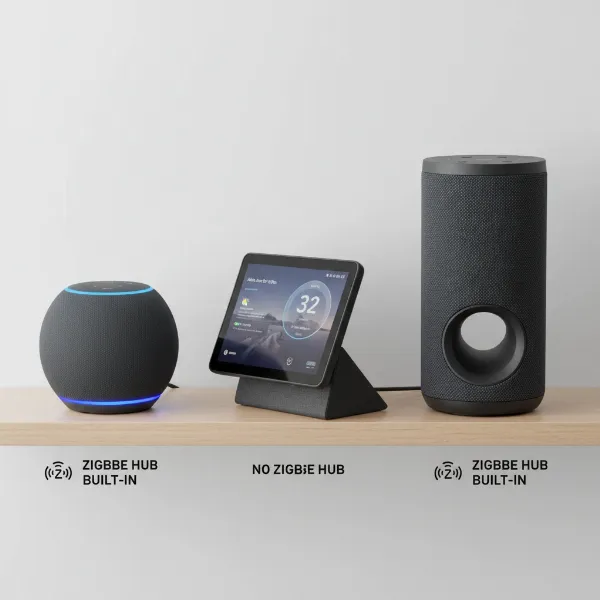
In an increasingly connected world, our homes are becoming smarter, more responsive, and, ideally, more secure. Smart speakers, once simple voice assistants for music and weather, have evolved into versatile components of a comprehensive home security strategy. While dedicated “Guard Mode” features, such as the original Alexa Guard, have transitioned, smart speakers continue to offer invaluable layers of protection. Understanding how these devices integrate into your security setup is key to leveraging their full potential.
The Evolution of Smart Speaker Security: From Alexa Guard to Emergency Assist
The journey of smart speakers as security devices began with innovative features designed to offer peace of mind. These capabilities have continually adapted, providing more sophisticated protection over time.
What Was Alexa Guard?
Amazon’s Alexa Guard was a groundbreaking free feature for Echo devices that allowed them to act as a rudimentary home security system when users were away. It leveraged the built-in microphones of Echo speakers to listen for specific sounds that could indicate an emergency. When activated, typically by saying “Alexa, I’m leaving,” it would enter an “Away” mode.
Alexa Guard’s primary functionalities included detecting the distinct sounds of smoke alarms, carbon monoxide detectors, and breaking glass. Upon detection, it would send smart alerts to the user’s smartphone, often including a short audio clip for verification. Additionally, it could integrate with smart lights to turn them on and off randomly, creating the illusion of occupancy to deter potential intruders. It also had a “Home” mode that would notify you of alarm sounds even when you were home. However, Amazon officially discontinued Alexa Guard in January 2024, migrating its core functionalities to a new subscription service.
The Transition to Alexa Emergency Assist
Following the discontinuation of Alexa Guard, Amazon introduced Alexa Emergency Assist, a paid subscription service designed to provide more robust emergency response capabilities. This new service effectively integrates and enhances many of the features previously found in Alexa Guard and Alexa Guard Plus.
Alexa Emergency Assist offers several key features that empower your smart speaker for security:
- Advanced Sound Detection: It continues to detect the sounds of smoke alarms, carbon monoxide alarms, and glass breaking, sending smart alerts directly to your phone.
- Emergency Helpline Access: Subscribers gain hands-free access to a 24/7 emergency helpline. By simply saying “Alexa, call for help,” users can connect with trained agents who can assess the situation and dispatch emergency services (police, fire, or EMS) on their behalf. This is a significant upgrade from the original free Guard.
- Emergency Contacts: Users can designate a list of emergency contacts who will be automatically notified if Alexa detects an emergency or if the “call for help” command is activated.
- Stored Critical Information: The service allows you to pre-save important information, such as gate codes, medical conditions, or pet details, which can be shared with emergency responders to facilitate quicker and more informed assistance.
- Intruder Deterrent Sounds: Alexa Emergency Assist can play deterrent sounds, like a dog barking or a siren, to scare off potential intruders when unusual activity is detected.
The service costs $7.99 per month or $79 per year for non-Amazon Prime members, with a slightly reduced rate for Prime subscribers. It is compatible with a wide range of Echo devices.
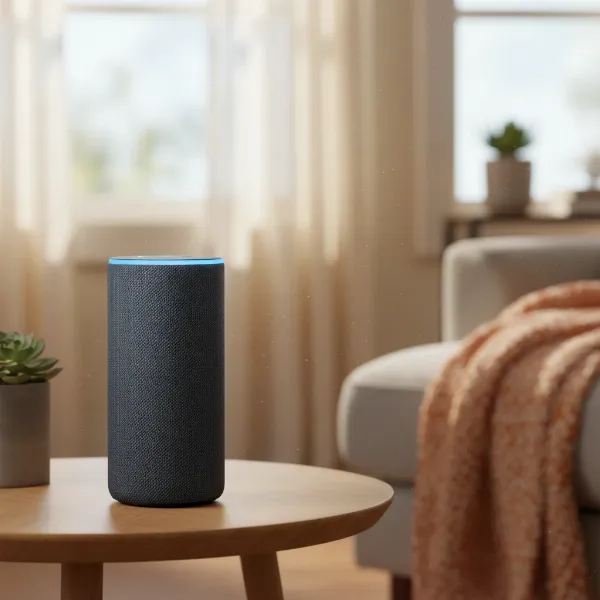 A smart speaker actively listening for emergency sounds in a modern living room setting
Remaining Free Features
Even without an Alexa Emergency Assist subscription, some valuable security-enhancing features remain available on Amazon Echo devices. These include “Away Lighting,” which can still randomize connected smart lights to simulate occupancy, and “Home and Away Modes” for controlling other smart home functionalities. These can be configured through the standard Alexa app without an additional fee.
Beyond Amazon: Other Smart Speaker Security Capabilities
While Amazon has refined its security offerings, other smart speaker ecosystems and general smart home integrations also provide valuable security functions.
Google Nest and Home Security
Google Nest speakers and displays are integral to the Google Home ecosystem, which features its own robust suite of security devices and services. Google Nest devices, particularly those with built-in cameras like the Nest Hub Max, can offer visual and auditory monitoring.
Google’s security offerings, often enhanced by a Nest Aware subscription, include advanced motion and sound detection with smart cameras and doorbells. Nest Aware provides extended video history, familiar face alerts, and in some cases, the ability for your Nest speaker to detect unusual sounds and alert you. While Google Home previously lagged slightly in sensor-triggered routines compared to Alexa, its ecosystem offers tight integration with Nest security cameras and doorbells, allowing users to view live feeds on Nest Hubs or even Chromecast-enabled TVs. An upcoming Nest Aware update is also expected to introduce an emergency call feature.
General Integration with Third-Party Security Systems
Smart speakers from both Amazon and Google can serve as control hubs for a wide array of third-party home security systems and devices. These integrations extend the reach of your smart speaker beyond its native capabilities. You can voice-control systems like Ring Alarm, ADT, SimpliSafe, and Vivint to arm or disarm your security system, check sensor status, or view camera feeds on smart displays. This interoperability allows users to build a customized security network tailored to their specific needs, using their smart speaker as the central command point.
Drop-In and Two-Way Communication
Most smart speakers, especially those with microphones and speakers (and cameras on smart displays), offer a “Drop In” feature. This allows users to remotely connect to an Echo or Nest device and listen to the ambient sounds in the room or initiate two-way communication. This can be incredibly useful for checking in on pets, confirming a strange noise, or communicating with family members while away. On devices like the Echo Show or Nest Hub Max, the Drop In feature can also enable live video feeds, transforming your smart speaker into a basic surveillance camera.
Motion and Sound Detection (Generic)
Even without dedicated “Guard Mode” subscriptions, many smart speakers can integrate with external motion and sound sensors through smart home routines. For instance, a smart speaker can announce when a connected motion sensor detects movement in a specific area or when a smart doorbell is pressed. While this might require additional smart home hardware, it allows for custom security alerts and automations, providing flexibility in how you monitor your home.
Choosing a Smart Speaker for Enhanced Home Security
Selecting the right smart speaker to bolster your home security involves careful consideration of several factors.
Assess Your Needs and Existing Setup
Before diving into features, consider what kind of security you need and what smart home devices you already own. Do you need basic sound detection, or professional monitoring? Are you looking for a system that integrates seamlessly with your existing smart lights, locks, or cameras? Your budget, comfort with subscriptions, and technical proficiency also play a role in this decision.
Key Features to Look For
When evaluating smart speakers for security, prioritize features that align with your requirements:
- Sound Detection Capabilities: Understand whether sound detection for alarms or glass breaking is a free or paid feature, and what types of sounds are detectable.
- Emergency Services Access: For professional monitoring and direct emergency contact, services like Amazon’s Emergency Assist are crucial.
- Smart Home Integration: Ensure compatibility with your preferred smart locks, lights, and cameras for comprehensive automation.
- Camera Compatibility: If visual monitoring is important, a smart display that can show camera feeds is a must.
- Privacy Considerations: Research how each platform handles recorded audio and video, and understand your privacy settings.
“The true power of a smart speaker in home security lies not just in its individual features, but in its ability to seamlessly weave together disparate smart home devices into a cohesive protective network.” – Dr. Evelyn Reed, Smart Home Security Expert
Privacy and Data Security
The use of microphones and cameras in smart speakers for security purposes naturally raises privacy concerns. Reputable manufacturers employ encryption for data in transit and at rest, and offer user controls over recordings and data retention. It is essential to configure privacy settings diligently, such as enabling auto-delete schedules for recordings, to balance security benefits with personal privacy.
Maximizing Your Smart Speaker’s Security Potential
To truly transform your smart speaker into a robust security device, strategic implementation and regular maintenance are key.
Strategic Placement
The effectiveness of sound detection hinges on placement. Position your smart speaker in a central location where it can best “hear” the sounds it’s programmed to detect, such as near windows for glass breaking or within earshot of smoke/CO alarms. For optimal coverage, consider distributing multiple Echo or Nest devices throughout your home. Testing the placement with a simulated alarm sound can help confirm its effectiveness.
Integrate with Smart Home Devices
Maximize your smart speaker’s security role by integrating it with other smart home devices. Connect smart lights to create “Away Lighting” routines, link smart locks for remote locking and status checks, and pair security cameras or video doorbells to view live feeds on smart displays. These integrations create a dynamic defense system. For instance, if a smart doorbell detects motion, your smart speaker could simultaneously turn on exterior lights and send you an alert.
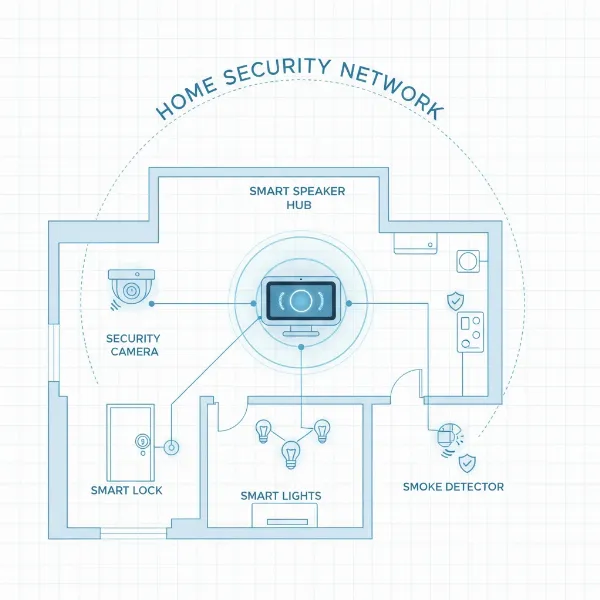 Smart speaker as a central hub controlling various smart home security devices
Set Up Routines and Automations
Automate your security with custom routines. Create a “Leaving Home” routine that activates away lighting, arms your security system (if integrated), and puts your smart speaker into its security monitoring mode. A “Good Night” routine could lock doors, turn off lights, and enable overnight monitoring. These automations simplify your security management and ensure consistent protection.
Regular Software Updates
Keep your smart speaker’s software and the accompanying app updated. Manufacturers frequently release updates that include security patches, new features, and performance improvements. Staying current ensures your device operates with the latest protections and functionalities.
Comparison of Smart Speaker Security Features
| Feature / Service | Amazon (Emergency Assist) | Google Nest (Nest Aware) | General Smart Speaker (via 3rd party) |
|---|---|---|---|
| Sound Detection | Yes (Smoke/CO/Glass Break – paid) | Via Cameras/Sensors (paid) | Via specific accessories (paid/free) |
| Emergency Helpline Access | Yes (24/7, agent dispatches – paid) | Via Nest Aware (coming soon – paid) | No (direct 911 call from phone) |
| Away Lighting | Yes (Free) | Yes (via routines) | Yes (via routines) |
| Voice Control for Security | Yes (Arm/Disarm, status) | Yes (Arm/Disarm, status) | Yes (via compatible skills/actions) |
| Smart Home Integration | Ring, ADT, smart lights, locks, cameras, etc. | Nest cams/doorbells, smart lights, etc. | Broad (Zigbee, Matter, Wi-Fi) |
| Remote Audio Monitoring | Yes (Drop In) | Yes (Drop In) | Limited (depends on device) |
| Remote Video Monitoring | Yes (Echo Show Drop In) | Yes (Nest Hub/Max) | Via integrated cameras on displays |
Conclusion
Smart speakers have evolved significantly from mere music players, establishing themselves as valuable assets in modern home security. While Amazon’s specific “Guard Mode” has transitioned into the more advanced, subscription-based Alexa Emergency Assist, the underlying principle remains: these devices offer accessible and intelligent ways to enhance your home’s safety. From detecting critical sounds and deterring intruders to acting as central control points for your wider smart home security system, smart speakers provide layers of protection that were unimaginable a decade ago. By understanding their capabilities, integrating them thoughtfully, and managing privacy settings, you can harness the power of your smart speaker to create a more secure and responsive living environment.
Are you ready to unlock the full security potential of your smart speaker?
Frequently Asked Questions
Is Alexa Guard still available?
No, the free Alexa Guard service was officially discontinued by Amazon in January 2024. Its core sound detection features have been migrated to the new, subscription-based Alexa Emergency Assist service.
What is Alexa Emergency Assist?
Alexa Emergency Assist is Amazon’s current paid subscription service that provides advanced home security features for Echo devices. It includes sound detection for emergencies, 24/7 access to an emergency helpline, emergency contact notifications, and stored critical information for responders.
Can Google Nest speakers act as security devices?
Yes, Google Nest speakers can integrate with the Google Home security ecosystem, including Nest Cams and Nest Doorbells. With a Nest Aware subscription, they can offer advanced sound/motion detection and are expected to include emergency call features. They also support routines for security actions.
How accurate is smart speaker sound detection?
Smart speaker sound detection, such as that in Alexa Emergency Assist, is designed to identify specific patterns like smoke alarms, CO alarms, or glass breaking. While generally effective, environmental factors can sometimes influence accuracy. It is recommended to test features and ensure proper speaker placement.
Do smart speakers replace traditional home security systems?
Smart Speakers, even with advanced features like Emergency Assist, typically complement rather than entirely replace traditional home security systems. They offer valuable monitoring and alert capabilities but may lack the comprehensive sensor coverage, professional installation, and robust siren systems of dedicated security setups.